
Biography
A BIOGRAPHY OF TITUMIR

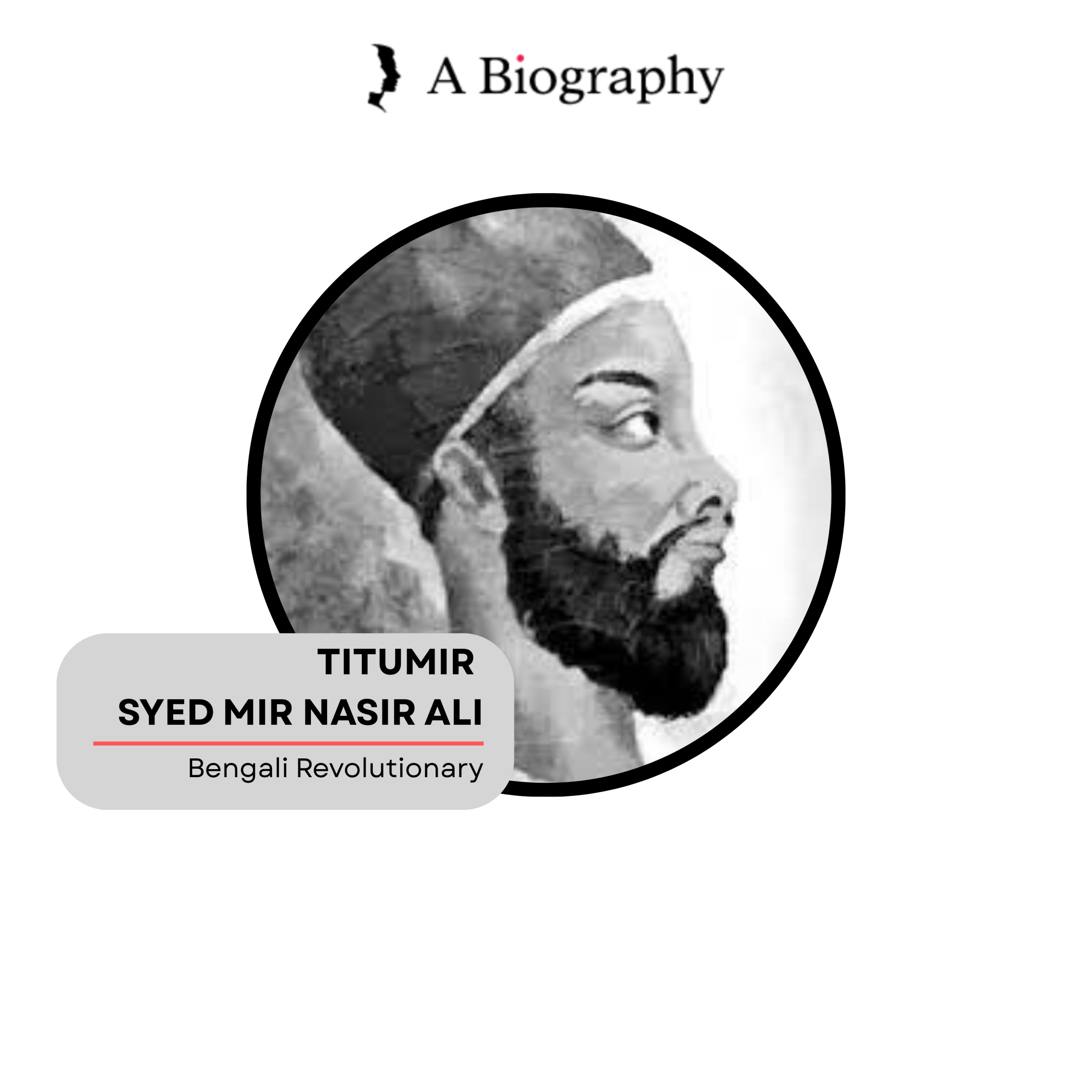
A biography of Titumir
Bengali Revolutionary
(27 January 1782 – 19 November 1831)
Table of Contents
ToggleSummary
On November 19, 1831, on one side thousands of trained British soldiers with large quantities of ammunition, on the other a common Bengali, with extraordinary courage and infinite fortitude, leading an unarmed army. Although it seems like a story, the scene is a burning reality and the fearless hero is none other than Bengal’s first revolutionary, Titumir.
Titumir was born on January 27, 1782, in Chandpur, twenty-four Parganas of West Bengal. His father’s name is Syed Mir Hasan Ali and his mother’s name is Abida Rokaia Khatun. He was born into a Sunni Muslim family believed to be descended from Hazrat Ali Ibn Abu Talib.
Titumir’s real name is Syed Mir Nisar Ali. But the story behind the naming of Titumir is quite interesting. Once he got very sick. The doctor prescribed him a medicine that everyone from children to the elderly was reluctant to take. But to everyone’s surprise, Titumir started eating that bitter medicine with great satisfaction. Since then Syed Mir Nisar Ali became recognized as Titumir.
Apart from being an outstanding scholar of the Quran and philosophy, he was also widely known as a wrestler. A visit to the city of Mecca in 1822 changed the entire course of his life. He took a firm commitment to protest against injustice.
Returning home in 1827, he spoke out against the tyrannical landlords and the British. Attracted by his bravery and righteousness, many Muslims and Hindus started joining his force.
After going to Narkelbaria on October 27, 1831, he built a bamboo fort for self-defense on the one hand and prepared for an armed war on the other. When the conspiracies of the British and Zamindars repeatedly failed in the face of Titumir’s extraordinary military tactics, the British resorted to the strategy of using all their might.
Finally, on November 19, under the orders of the then Governor of India, Lord William Bentinck, Colonel Stewart attacked the Bamboo Fort with thousands of trained soldiers and a large amount of ammunition. Despite putting up stiff resistance, fighting the well-trained British military proved impossible. He could have surrendered if he wanted. However, this hero never learned to bow down against injustice. So he accepted death with utmost respect without begging for life.
The deep self-sacrifice of this brave rebel of Bengal will be forever remembered in the hearts of all Bengalis.
Introduction
19 November 1831, a historical day blended with utmost pride and tremendous grief for every Bengali. On the one hand, thousands of trained British soldiers with a massive amount of ammunition, and on the other, an ordinary man, leading an unarmed force of just hundreds of common people embellished with extraordinary determination and dedication. Could you even wonder, how an ordinary man can even stand with so much courage against such a ferocious armed force with no fear in soul? However, the whole spectacle was a precise reality as the valiant soul was none but the hero of Bengal, Titumir.
Syed Mir Nisar Ali, widely known as Titumir was a Bengali revolutionary who was one of the first shields of Bengal who devastated the whole Empire of the injustice rulers with just a bamboo stick. He built the historical “Bamboo Fort” to confront the British Forces and till his last breath, the lion-hearted hero fought heart and soul to save the Bengal. The title truly goes to him as he is honored as the “Greatest Bengali of All Time”.
So, without more delay, let’s dive into the glorious life journey of the hero of Bengal, Titumir.
Life of "Titumir" at a Glance:
Personal Details
➢ Full Name: Syed Mir Nisar Ali (Titumir)
➢ Date of Birth: 27 January 1782
➢ Birth Place: Chandpur, 24 Parganas, Bengal (now West Bengal, India)
➢ Died: 19 November 1831 (aged 49)
➢ Cause of Death: Killed in battle against British forces
➢ Burial Site: Unknown (body never recovered)
➢ Religion: Islam (Sunni)
➢ Nationality: Bengali (pre-colonial India)
Education
➢ Early Education: Local Maktab and Madrasa
➢ Languages: Arabic, Bengali, Persian
➢ Specialization:
-Hafiz-e-Quran (Memorized the Quran)
-Islamic theology, philosophy, and jurisprudence
-Studied in Mecca (1822–1827) under reformer Saiyid Ahmad
Career & Contributions
➢ Islamic Reformer:
-Preached against Bid’ah (innovations) and Shirk (polytheism
-Led the Tariqah-i-Muhammadiya movement in Bengal
➢ Revolutionary Leadership:
-Formed a Mujahid Force of peasants and farmers
-Trained forces in combat using bamboo sticks (lathi khela)
➢ Engineering Feat:
-Built the Bamboo Fort (Bansher Kella) at Narkelbaria (1831)
Role in Anti-British Resistance
➢ Organized protests against oppressive taxes by Hindu zamindars and the East India Company
➢ Defeated multiple British-led forces in 1830–1831
➢ Declared himself Badshah (King) of his autonomous zone
➢ Final battle: Colonel Stewart’s artillery destroyed the Bamboo Fort (19 November 1831)
Legacy & Honors
➢ BBC Poll: Ranked 11th in “Greatest Bengali of All Time” (2004)
➢ Commemorations:
-Government Titumir College (Dhaka)
-BNS Titumir (Bangladesh Navy base)
-Commemorative stamp (1992)
➢ Cultural Depictions:
-Play: Titumir-er Basher Kella (1967)
-Novella by Mahasweta Devi
-Drama by Utpal Dutt
Little-Known Facts
➢ Worked as a wrestler (pahlwan) and bodyguard for a local zamindar in his youth
➢ Imprisoned for years due to conflicts with zamindars before his pilgrimage to Mecca
➢ Named “Titumir” for fearlessly consuming bitter medicine as a child
➢ His force included both Muslims and Hindus oppressed by zamindars
Early Life & Background
Titumir was born on 27 January 1782 (14 Magh 1188 BS) as Syed Mir Nisar Ali. His birthplace is Chandpur (controversially Haiderpur), under the subdivision of Bashirhat in the district of 24 Parganas in West Bengal. He was born to Saiyid Mir Hasan Ali and Abida Rokaiya Khatoon. The family is claimed to be the descendant of Caliph Hazrat Ali (R).
The Hereditary Title of ‘Saiyid’ and ‘Mir’
According to some scholars, Saiyid Shahadat Ali, the predecessor of Hazrat Ali (R) came to Bengal from Arabia to preach the holy religion, Islam. Later, the son of Shahadat Ali, Saiyid Abdullah was specified as the chief Qazi of Jafarpur by the emperor of Delhi. Within the duration, Saiyid Abdullah was honored with the title of “Mir Insaaf” for his righteousness in his responsibilities. Thus, the descendants of Shahadat Ali started to use both “Saiyid” and “Mir” as their hereditary titles.
Story Behind the Name ‘Titumir’
The story of becoming Syed Mir Nisar Ali to Titumir is quite interesting. When Titumir was a child, he became very ill. His parents became severely anxious and immediately took him to a physician. The physician observed him and prescribed a medicine for Titumir. But here something facetious happened. The medicine was so much bitter that even the old people used to express reluctance to take it. Thus, the parents became even more stressed. They were pondering how their little one was going to intake such a bitter remedy.
Despite that, leaving everyone shocked, the little one surprisingly took the remedy like a piece of cake for a long time without even shilly-shallying. That’s how he gradually became recognized as ‘Titu’ (Bitter) and later one of his original names ‘Mir’ was added to the one. Thus Syed Mir Nisar Ali became everyone’s beloved ‘Titumir’.
A Hafiz in the Quran
From a very early age, Titumir was a quite bright learner. He finished his primary education at a nearby village Maktab and then studied in a madrasa. By the age of 18, he became a hafiz in the Quran along with excelling in three different languages, Arabic, Bangal, and Persian.
Titumir had an avid thirst for knowledge. After completing his education in a local madrasa, he decided to develop his knowledge of Arabic and Persian literature. He was even embellished with adequate mastery in philosophy, Islamic theology, Islamic mysticism (Tasawwaf), jurisprudence, and mantiq.
The renowned Wrestler
Besides, being an exceptional polymath of Islam, Titumir was also a proficient gymnast. During that time, he was widely recognized for his unique strategies in gymnastics. Very soon, he gained immense fame as a renowned wrestler (Pahlwan). Later, he served a local Zamindar as the bodyguard for some while.
Dreadfully, very soon a conflict occurred around his locality and unfortunately, the impact also fell on him as well. On account of the conflict, Titumir became a prey to the zamindars and as a result, he had to face severe humiliation along with jail for years. In 1822, he was released from jail and thus became determined to forget the regretful past and start afresh.
The Historical Battle against the Zamindars and the Company
In 1822, Titu Mir went to Makka for a pilgrimage. There, he met an Islamic preacher and reformer, Saiyid Ahmad. The Islamic preacher was none less than a dazzling pearl who brought a soothing gleam to Titumir’s restive heart. He brought Titumar closure to his glaring soul which abolished all the darkness and finally, Titumir was aware of the true essence of Islam.
After five years, Titumir decided to return to his native from Makka in 1827. As soon as coming back, he started to preach Islam to the Muslims in the districts of Nadia and 24 Paraganas. He advised all Muslims to refrain from Bidaat and Shirk which are considered to be major sins in Islam. In a short while, all the Muslims began to practice Islam according to the advice of Titumir. In fact, observing the reflection of the beauty of Islam on Titumir, even some of the non-muslims determined to follow the way of Islam.
Very soon, Titumir became a man of utmost respect and honor to the locals. However, the local Hindu Zamindars could not indulge the matter. They turned green with envy. As a consequence, one of the Hindu Zamindars of Purha, Krishnadeva Rai imposed some baseless taxes to settle the score with the innocent Muslims. Titumir was very clear about the evil motives of the zamindars. Soon, he happened to conflict with some of the Hindu zamindars like Devanath Rai of Gobra-govindpur, Gauri Prasad Chowdhury of Nagpur, Rajnarayan of Taragonia, and Kaliprasanna Mukhopadhyay of Gobardanga.
To protect the Muslims and the natives, Titumir formed a Mujahid Force, ‘Tariqah-I-Muhammadiya’ in Bengal against the oppression. His nephew, Ghulam Masum was designated the commander of the force. Soon, the force started to train all the peasants with bamboo sticks. However, the rising acceptance of Titumir became a severe headache for the Zamindars. They began to plan several conspiracies against Titumir. But all the time Titumir’s incredible tactics were enough to make them fall up to knee. Thus, finally, the Zamindars hit upon a plan and started to instigate the English against Titumir.
Being instigated by the Hindu Zamindars, the English decided to fight against Titumir. They advanced a force led by the Zamindar of Gobardanga, and the English Kuthial (Factor) of Mollahati, Davis. However, the force could not stand much longer as it was beaten back by Titumir. In fact, the Zamindar of Gobardanga was slaughtered during the conflict. To take revenge, the collector of Barasat, Alexander, advanced another force against Titumir. But even this time, the force of Alexander had to flee. Being repeatedly attacked by the English and the Zamindars, Titumir decided to file a complaint to the East India Company (the government of the then). Even after so many legal attempts, he got no response from the government.
Thus, Titumir became very much assured that there was no option left to save the people but war. Soon, Titumir determined to train the whole force with advanced military training. As the people of Bengal were quite well aware of the evil motives of the Zamindars and the Company, they decided to knot with the Mujahid Force. In a short while, the number of the force reached about five thousand. After finishing all the military preparations, Titumir declared himself as the Badshah and motivated his force to fight against the British.
Ttitumir established a strong coverage over the districts of Nadia, 24 Parganas, and Faridpur. He called on tax from the Zamindars of Gobardanga and Taki, who were then imploring protection from the English. However, the authorities completely denied this, and as a consequence, the English advanced a combined force from Calcutta of the Zamindars and the Company against the Mujahid Force of Titumir. This time, the combined force was also brutally defeated by the troops of Titumir.
The History of the Historical Bamboo Fort
In 1831, when the Mujahids were constantly challenged by the English and the Zamindars, Titumir became destined to be noted in history with his notable Basher Kella (Bamboo Fort). Along with the Mujahid Force, Titumir himself decided to structure the fort in Narkelbaria. The Fort was fabricated with mud along with bamboo stakes and after that baked in the heat of the sun.
Basher Kella was not just a fort of defense. Rather it was a symbol of the tremendous courage and dedication of the peasants who were never afraid of standing in front of the injustice of the British Empire even with weapons like bamboo sticks.
Final Confrontation
Very soon, the Governor General of India, Lord William Bentinck became aware of the matter. He immediately sent an English army against Titumir led by Lieutenant Colonel Stewart. The troop consisted of all the advanced weapons along with 300 native infantry, 100 cavalry, and two cannons. On the day of 14 November 1831, the English launched the battle against the Mujahid Force.
Even though structured such an incredible Bamboo Fort, the Mujahids could not resist this time as they were completely helpless with their traditional weapons to such advanced arms of the English. On 19 November, the English announced fire and in a blink of an eye, the fort was destroyed. Along with the valiant figure, Titumir, many Mujahids had to embrace death in the war. Including the commander, Ghulam Masum, nearly 350 mujahids were captured by the English. Later, the commander was sentenced to death and the others were sentenced to imprisonment.
Achievements and Honoraries
Titumir, the valiant son of Bengal was none but a blessing for the nation. Even though the Muslims and the middle-class Hindus were always by his side, regretfully his deep devotion could never rise because of the conspiracies of the English. Some of the well-known media of the then time like Reformer, Samachar Chandrika, Jnananveshan, and so on were completely controlled by the Hindu Zamindars. Without any investigation, the whole media declared him as a law-and-order nuisance. Even the newspapers and journals took the government line as they were also funded by Englishmen and Christian missionaries.
Even after all their efforts, the truth rose like clear crystal. Very soon, the world became aware of all the evil efforts of the Englishmen including the Zamindars and Titumir became recognized as the most courageous heroes of the Bengal. In 2004, the BBC’s poll honored Titumir by ranking him number 11 of the “Greatest Bengali of All Time”.
Legacy
The proverb, ‘Every cloud has a silver lining’ waves straight to Titumir. Even after so many conspiracies of such opulence, the truth of the hero didn’t remain folded. The whole world even including the English had to bow to the bravery of Titumir.
In 1967, a play drama titled “Titumir-er Basher Kella” was broadcast on the PTV (now Bangladesh Television). The drama was based on a graphic novel directed by Sheikh Kamal that gained immense fame around East Pakistan. Moreover, the Jinnah College of Dhaka was also renamed after the valiant figure as Government Titumir College in 1971. Besides, the Government of Bangladesh issued a commemorative stamp on 19 November 1992 (the 161st death anniversary of Titumir) in his honor. Apart from that, “BNS Titumir” is titled to the principal base of the Bangladesh Navy to commemorate the valiance of the hero.
Including Bangladesh, the neighboring country, India also never forgot to honor the hero of Bengal. The well-known writer, Mahasweta Devi recovered the subaltern history of Titumir through his notable novella “Titumir” to uphold the real story to the world. Besides, the popular Indian director, Utpal Dutt directed “Titumir”, an agitprop drama that received critical appreciation worldwide.
Unknown Facts
➢ The real name of Titumir was “Syed Mir Nisar Ali”.
➢ His ancestry is known as the descent from Caliph Ali Ibn Abi Talib (R).
➢He used to intake bitter medicine surprisingly easily. That’s the reason, he became widely recognized as Titumir.
➢Besides being a Hafiz in the Quran along with having avid knowledge of Arabic, Bengali, and Persian, he was also one of the most popular wrestlers in Bengal.
➢He is remembered with utmost respect and honor for his greatest contribution during the movement of Tariqah-i-Muhammadiya and the Indian Independence movement.
➢Titumir was the constructor of the historical Basher Kella (Bamboo Fort) at Narkelbaria near Barasat in 1831.
Conclusion
Titumir was a man with tremendous courage and valor who never bowed to any injustice for the sake of his nation. He was not just a ruler but rather a whole symbol who is still inspiring all the generations to stand against injustice no matter how opulent the enemy is. Thus the lion-hearted hero will always remain like a beat in crore of hearts no matter how far the time flies.
References
https://en.wikipedia.org/wiki/Titumir
https://en.banglapedia.org/index.php/Titu_Mir
https://www.thedailystar.net/remembering-the-martyr-51285
https://www.daily-bangladesh.com/english/national/35973
https://www.kalerkantho.com/online/Islamic-lifestylie/2017/11/19/567567
Disclaimer :
All content on this website is provided in good faith and only for general information purposes. A Biography makes no guarantees regarding the information’s completeness, reliability, or correctness. Any action you take as a result of the material on this website is entirely at your own risk. A Biography is not responsible for any losses or damages incurred as a result of using our website.

