
Biography
A BIOGRAPHY OF AKHTER HAMEED KHAN

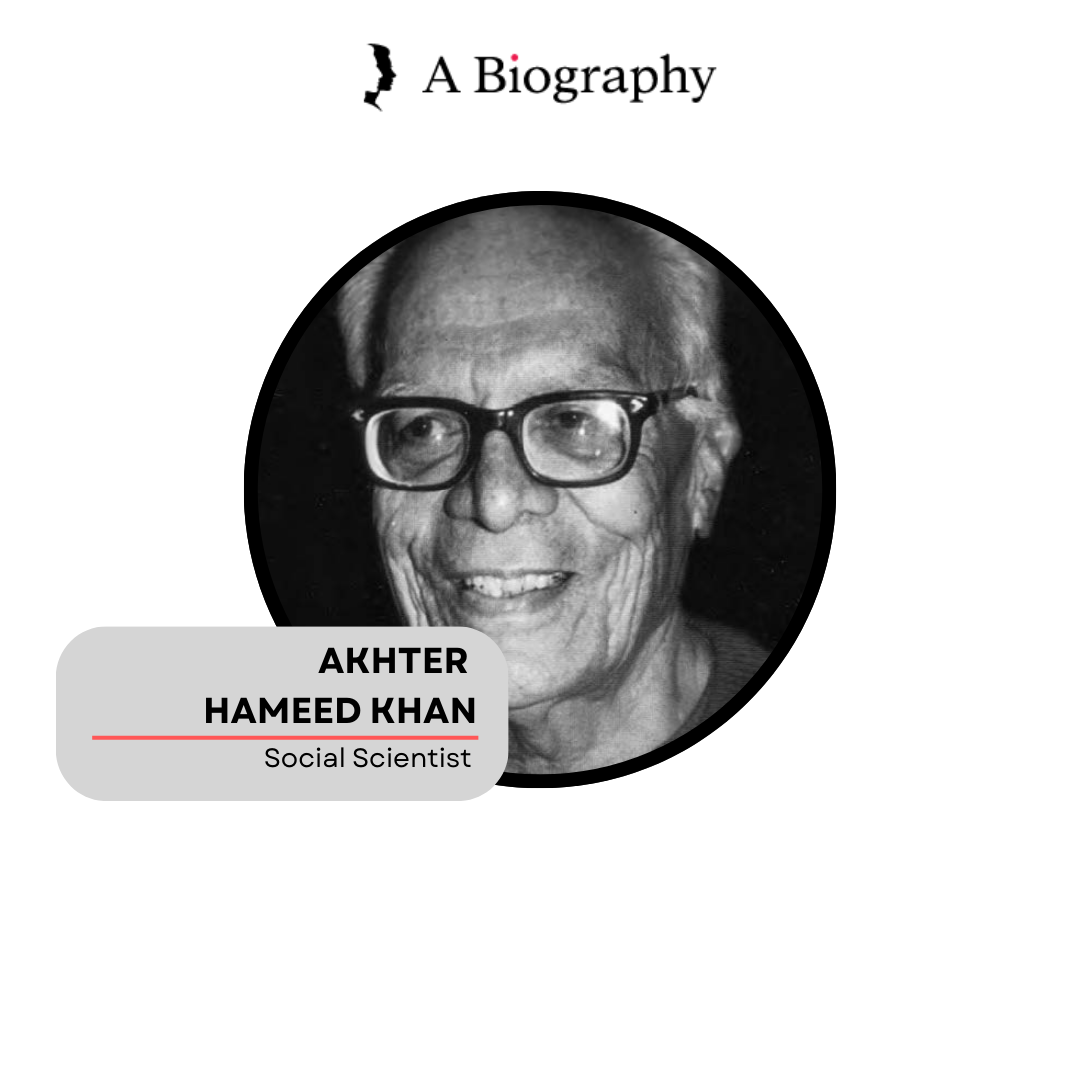
A biography of Akhter Hameed Khan
Social Scientist
15 July 1914 – 9 October 1999
Summary
If one has to recall the name of a Pakistan-Bangladeshi social development worker and a social scientist, the first name that comes to mind is Akhter Hameed Khan. He worked on the development of rural areas in West Pakistan and also contributed to East Pakistan and other developing countries. He is particularly known for establishing the Comilla Project in 1959. For this achievement, he was awarded the Ramon Magsaysay Award from the Philippines, along with an honorary Doctor of Law degree from the University of Michigan.
Introduction
Akhter Hameed Khan was born on July 15, 1914. His father was Khansahib Ameer, and his mother was Mehmooda Begum. He studied at Jalam Government High School in Uttar Pradesh and later pursued higher education at Agra College in 1930, where he studied English Literature and History.
In 1940, Akhter Hameed Khan married Hamida Begum, the eldest daughter of Allama Mashriqi. They had three daughters—Mariam, Amina, and Rasheeda—and one son, Akbar. After the death of his first wife, he married Shafiq Khan, and from this marriage, they had a daughter named Ayesha.
He earned his Bachelor’s degree from Meerut College. After completing his career as a lecturer, he joined the Indian Civil Service. As part of his training, he was sent to Magdalene College, Cambridge, UK, to study History and Literature. Upon returning to Pakistan, he was requested to implement his Comilla Model in rural areas of Pakistan, but he declined, as it was originally proposed for the North-West Frontier Province, Punjab, and Sindh.
After the death of Akhter Hameed Khan, the Government of Pakistan renamed the National Center for Rural Development to “Akhter Hameed Khan National Center for Rural Development and Municipal Administration”.
In 1999, at the age of 85, he passed away in Indianapolis due to a heart attack. After his death, on October 15, his body was brought to Karachi, where he was laid to rest.
Akhter Hamid Khan was a Pakistan-bangladeshi born social scientist. He was also a development practitioner. In West Pakistan he developed the rural areas. Also in East Pakistan and other developing countries. He was famously known for establishing the Comilla project of 1959 which earned him the award Ramon Magsaysay from the country Philippines as well as Doctorate of law from the University of Michigan.
Life of “Akhter Hameed Khan” at a Glance
Personal Details
➢ Full Name: Akhter Hameed Khan
➢ Date of Birth: 15 July 1914
➢ Birth Place: Agra, British India (now India)
➢ Died: 9 October 1999 (aged 85)
➢ Cause of Death: Myocardial infarction (heart attack)
➢ Burial Site: Orangi Pilot Project (OPP) office compound, Karachi, Pakistan
➢ Religion: Islam (Sunni)
➢ Nationality: Pakistani-Bangladeshi
➢ Languages: Fluent in Arabic, Bengali, English, Hindi, Persian, and Urdu
Education
➢ Early Education: Government High School, Jalam (Uttar Pradesh)
➢ Higher Education:
-BA (Literature, History, Philosophy) – Meerut College (1932)
-MA (English Literature) – Agra University (1934)
-ICS Training – Magdalene College, Cambridge (UK)
➢ Honorary Doctorate: Doctor of Laws, Michigan State University (1964)
Career & Contributions
➢ Rural Development Pioneer:
-Founded Pakistan Academy for Rural Development (PARD), Comilla (1959)
-Developed the Comilla Model (integrated cooperatives, training, and infrastructure)
-Directed Orangi Pilot Project (OPP) (1980–1999), focusing on low-cost sanitation, microcredit, and self-help initiatives in Karachi slums .
➢ Key Philosophies:
-Community-led development over top-down interventions .
-Self-reliance through micro-savings, local training, and simple technology .
➢ Global Influence:
-Advised governments in Indonesia (World Bank, 1974) and Pakistan
-Visiting professor at Harvard, Oxford, and Lund University .
Role in Development History
➢ Resigned from Indian Civil Service (1945) to protest colonial neglect during the Bengal famine .
➢ Rejected politically motivated projects (e.g., declined to replicate Comilla Model in Punjab/Sindh without community buy-in) .
➢ Mentored future leaders like Muhammad Yunus (Grameen Bank) and Fazle Hasan Abed (BRAC) .
Awards & Honors
➢ Ramon Magsaysay Award (1963) for rural development .
➢ Sitara-e-Pakistan (1961) and Nishan-e-Imtiaz (2001, posthumous) .
➢ Jinnah Award (2004, posthumous) for services to the people .
➢ Legacy Institutions:
-Akhter Hameed Khan National Centre for Rural Development (Islamabad) .
-Akhter Hameed Khan Resource Centre (Islamabad) .
Little-Known Facts
➢ Worked as a locksmith and laborer in Mamoola village (1945–1947) to understand rural poverty .
➢ Poet and writer in Urdu; published Chiragh aur Kanwal (poetry collection) and travelogues .
➢ Initially joined the Khaksar Movement but later embraced Sufism for spiritual grounding .
➢ His daughter, Dr. Ayesha Khan, continues his work through the Akhter Hameed Khan Resource Centre .
Legacy
➢ Comilla Model inspired global microfinance movements despite later cooperative failures .
➢ Orangi Pilot Project remains a benchmark for participatory urban development .
➢ Quoted: “Let the poor at least populate one city!” – reflecting his advocacy for marginalized communities
Early Life
Hamid khan was born on 15th July, 1914 in Agra. His father was Khansaahib Ameer and mother, Mehmoodah Begum. His mother was diagnosed with tuberculosis and died at the age of 36.His father was a police inspector. Reformist Syed Ahmed Khan inspired Mr. Ameer in many ways. His mother introduced him to the famous literary figures such as Rumi, Maulana Hali, Muhammad Iqbal, Abul Kalam Azad. After reading their poems and writing, Akhter hamid Khan was influenced in the historical, social, and political affairs.
Education
Hamid Khan went to Jalam Government High School in Uttar Pradesh. He completed his education from Agra College in 1930. He learned English Literature and history from there. He completed his bachelor degree of Arts from Meerut College. He learned English literature, philosophy and history at his uni. He completed his Master of Arts degree from Agra University in 1934. After that he worked as a lecturer at Meerut College.
Personal Life
Hameed Khan got married to the eldest daughter of Allama Mashriqi, Hameedah Begum in 1940. (Mariam, Amina, and Rasheeda- they were blessed with three daughters. And one son, Akber. After the death of his first wife he married Shafiq Khan. In his second marriage, he had one daughter named Ayesha.
Joining Indian Civil Service (ICS)
He joined the Indian civil service after being done with his career as a lecturer. As part of the training he was sent to learn history and literature at Cambridge Magdalene College of the United Kingdom. During his stay made friends with Choudhary Rahmat Ali. During his practice days, he collected revenues from the eastern rural area of Bengal. He resigned from the ICS after the 1943 famine of Bengal. Also he was disappointed by the handling of colonial rules. Later he said that he was lucky that he got to leave ICS while he was young and strong. If he did not escape he would have become a big bureaucratic. While he was staying in the Indian Civil Service, he was acquainted with the philosophy of Nietzche and Mashriqi. He also joined the group of Khakser movement.
Khakser movement was formed by Inayatullah Khan Mashriqi in 1931. The main goal of this group was to unite the country and oppose the partition of India. This movement also tried to free India from the British movement.
After Some time, he started practicing Sufism and quit the Khakser group.He always had a deep sense of personal freedom. He wanted to lead a conflict free life. He did not wanted to become a prisoner of fear and anxiety. He wanted a calm and serene life. Turning to Sufism helped him to be free of pride and greed and fears.
Working at Rural Community
Akhter Hameed Khan worked at a village called Mamoola which was situated near Aligarh. He worked there as a locksmith. This job helped him to understand the problems and issues of the rural areas. In 1947, he started working as a teacher at a school in Delhi, Jamia Millia. In 1950, he shifted to Karachi, Pakistan to teach at the Islamia College. During the same year, he got a letter of invitation from the Government of Pakistan to become the Principle of Comilla Victoria College. He joined there and worked until 1958. During this time he worked as the President of Non-governmental teachers’ association of East Pakistan.
During his service as the principal he developed an interest towards grassroots actions. He worked as a director of the Village Agriculture and Industrial Development(V-AID) in 1953. He took a break from his duty as a principal to work as the director of the village. But the program had some sort of limitation. That made him really dissatisfied. In 1958, he got admitted to Michigan State University to earn a degree in rural development. He returned from there in 1959. Then he established Pakistan Academy for Rural Development (PARD). at Comilla. As a matter of which he was appointed as the founding director of PARD on 27th May. In 1964, he was appointed as the vice chairman of the board of Governors of PARD. In the same year he was awarded an honorary doctorate of Law by his University Michigan State. He developed collaborative projects with Aurthur Lewis.
Other roles
When he returned to Pakistan, he was asked to implement his Comilla model in the rural areas of Pakistan but he declined. It was for the province of North-West Frontier of Pakistan. Punjab and Sindh. He declined the proposals because it was politically motivated and he did not want to become a part of it. But he continued to advise various authorities on different aspects of rural development, for example irrigation management. He also worked as an assistant researcher at the university of Agriculture which is situated in Faisalabad for one year. He also worked as the director of the rural Economics Research project at The Karachi University from 1972 to 1973. After that he decided to visit Michigan State University as a visiting professor in 1973 and stayed there till 1979. During his stay, he continued advising on the rural development project of Bogura in the north part of Bangladesh.. Also the Pakistan Academy for rural development which was called Peshwawar. It was on the Daudzai integrated Rural Development Programme. In 1974, he was elected as a consultant of the World bank. He surveyed the rural development situation at Java, situated in Indonesia. At Lund University, Harvard University and Oxford University he worked as a visiting professor. In 1980, Akhter Mahmood moved to Karachi to implement his improvement projects of Sanitary conditions in the suburbs of Karachi. At the Orangi city, he laid the foundation of Orangi Pilot projects for the Orangi community which is supposed to be the largest community of that city. He worked for this project till his death. In the meantime he contributed support for the rural and suburban areas of Karachi and also developed the Aga Khan Rural Support Programme. Orange Pilot Project (OPP) later became a model for bottom up development initiative projects.
Comilla Cooperative Pilot Projects
AS his previous role as V-AID was a failure, he decided to launch The Comilla project in 1959. V-Aid got technical assistance from the US. But V-AID remained as a government level project to advertise public participation in the rural areas for rural development.
Khan launched his Comilla project after returning from Michigan. He developed the methodology of the implementation technique on principle at the grassroots level. His initial aim was to provide replication of development projects across the country. Experts from the University of Harvard and Michigan State University provided advisory support. The Ford Foundation and the USAID also provided support for this project.
Through local integrated programmers and infrastructure systems Comilla Model Simultaneously addressed the underdevelopment problems. This project was established in the every thana of a training and development centre, road drainage embankment programmers, small scale decentralized irrigation programmers, primary two-tiered cooperative systems of the village areas, and federation operation at the sub-district level of the country.
Legacy
His leadership and ideology helped many students to gain what they wanted in their career. Edgar Owens became an admirer of Khan’s ideology at the time of his working at the Comilla Academy. Study of different rural development experiences from South Asia was dedicated to Khan and owens.
Just after the death of Akhter Hameed Khan, the government of Pakistan renamed the National Centre for Rural Development the Akhter Hameed Khan National Centre for Rural Development and Municipal Administration.
In 2005, Pakistani Social Sciences Council awarded Akhter Hameed Khan Memorial Award. The cash from the award was given to a Pakistani author for a book issued on rural and urban development , peace, poverty or gender discrimination. At the occasion ceremony in 2006, a documentary film on Akhter Hameed Khan was played where the film includes archival footage and interviews with the family members , and the contributors of Comilla and OPP projects. The Akhter Hameed Khan Resource centre was established in Islamabad.
Death
In 1999, he went to the USA to visit his family due to his heart failure. On 9th October of the same year he died of myocardial infarction at the age of 85 in Indianapolis. His dead body was flown to Karachi on October 15th. He was buried on the grounds of the OPP office compound.
Disclaimer :
All content on this website is provided in good faith and only for general information purposes. A Biography makes no guarantees regarding the information’s completeness, reliability, or correctness. Any action you take as a result of the material on this website is entirely at your own risk. A Biography is not responsible for any losses or damages incurred as a result of using our website.

