
Biography
A BIOGRAPHY OF JAHANARA IMAM

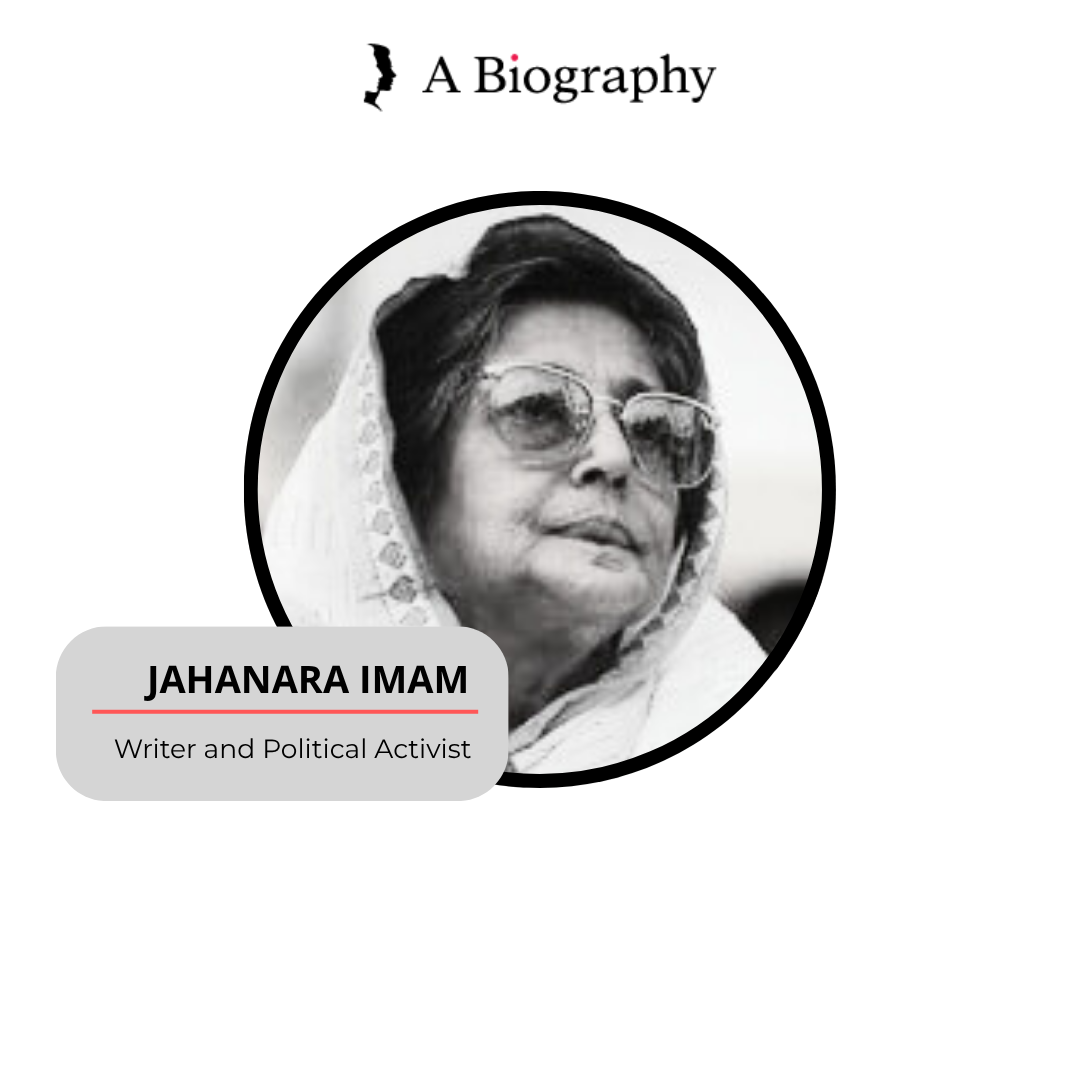
Biography of Jahanara Imam
Writer and Political Activist
(May 1929 – June 1994)
Table of Contents
ToggleSummary
Jahanara Imam, regarded fondly by people as the “Mother of Martyrs”, was a prominent Bangladeshi writer, teacher, and fighter for freedom whose mission left an indelible imprint on the history of the nation and raised the awareness of citizens about their own identity. Her life, punctuated by catastrophe, courage, and unwavering devotion to righteousness, is still a powerful symbol of resilience in the People’s Republic of Bangladesh. Her most notable contribution to history is the recording of several battles that took place during the Bangladesh Liberation War of 1971 in her diary Ekattorer Dinguli (Days of Seventy-One), where she also recounts the loss of her son during that conflict. Jahanara Imam, an activist for social justice, gives people a deep sense of admiration for her. She advocated for war criminals trials for a long time. Her life is proof of the principles of pardon, love for one’s country, and firm ethics.
Introduction
Jahanara Imam was quite simply a tragic icon—an activist, a patriot, a writer who cannot be forgotten among other women in the history of Bangladesh. With great determination and poise, she pledged her life to seek justice for the atrocities and crimes against humanity that took place during the Bangladesh Liberation War in 1971. She bore many facets at the same time, as a mother and wife, an educator, and a great author, but all was overshadowed by the events of 1971 that shocked her nation. Despite the painful memories of loss, she was motivated to strive for the good of others owing to the memories possessed by the great struggle. People still applaud her creation Ekattorer Dinguli, epitomizing the glory of Bangladesh’s history.
Life of “Ranada Prasad Saha” at a Glance
Personal Details
➢ Full Name: Jahanara Imam
➢ Date of Birth: 3 May 1929
➢ Birth Place: Murshidabad, West Bengal, British India (now India)
➢ Died: 26 June 1994 (aged 65)
➢ Burial: Mirpur Martyred Intellectuals’ Graveyard, Dhaka, Bangladesh
➢ Father: Dr. Mohammad Saadat Ali (physician)
➢ Mother: Hamida Begum
➢ Religion: Islam
➢ Nationality: Bangladeshi
➢ Spouse: Sharif Imam (engineer)
➢ Children: Two sons – Rumi (martyred in 1971) and Shafi Imam.
➢ Turned grief into activism after her son’s death.
Education
➢ Primary: Local school in Murshidabad
➢ Matriculation: Lady Brabourne College, Kolkata
➢ Higher Studies:
-BA in Bengali Literature (University of Dhaka)
-MA in Bengali Literature
Career & Contributions
➢ Teaching:
-Headmistress, Siddheswari Girls’ High School, Dhaka
Promoted progressive education for women
➢ Literary Works:
-“Ekattorer Dinguli” (1986) – A wartime diary documenting the 1971 Liberation War and her son’s martyrdom.
Authored several books on education and nationalism.
Activism:
➢ Led the Gono Adalat (People’s Court) movement in the 1990s to demand trials for 1971 war criminals.
➢ Symbolized as “Shaheed Janani” (Mother of Martyrs) for her relentless pursuit of justice.
Key Roles in 1971 Liberation War:
➢ Documented atrocities and personal losses in her diary.
➢ Inspired freedom fighters, including her son Rumi, who was martyred by the Pakistani army.
➢ Preserved historical evidence of war crimes.
Awards & Honors:
➢ Independence Award (1997, posthumous) – Bangladesh’s highest civilian honor.
➢ Recognized as a national icon for justice and literature.
Assassination Attempt & Death:
➢ Faced threats for her activism against war criminals.
➢ Died of cancer on 26 June 1994 in Michigan, USA.
➢ Buried with state honors in Dhaka.
Early Life and Background
On May 3, 1929, in Murshidabad, Bengal, the eastern part of the then British India, Jahanara Imam was born. She was born into a family that was relatively progressive: her father was a physician who had strong emphasis on learning and exposure to cultural activities. After finishing her early schooling, Jahanara decided to move to Kolkata, where she enrolled in the women’s Lady Brabourne College. After earning her bachelor degree, Jahanara returned to academia, focusing on Bengali Literature at University of Dhaka in order to further her education.
Her interest in education was complemented by her active participation in social composition, particularly in dancing. After meeting several prominent Bangladeshi writers, she began attempting to write herself in her early teens. Her teaching career undoubtedly affected Jahanara, the author, who in turn desired to inspire students to appreciate literature and have a critical mindset. At a later stage, she became the head mistress of Siddheswari Girls’ High School, following which she became active in educational development for Bangladeshi women.
Contributions
The contributions of Jahanara Imam are literary and social as well. Her writings are recognized for a distinct cause as they depict the struggle, the pursuit of Bangladesh, to find which it attaches and strives for – its roots. The most famous and prized work she created is Ekattorer Dinguli – which is the celebrated author’s diary she had been keeping. In this work of hers, she presented the overview of a variety of intricacies that the country was enduring. She lost her son Rumi, who joined the Mukti Bahini and ended up being arrested and executed by the Pakistani army. The book was published a few years after the war. Its reader acceptance was enormous and it embodies the idea of the great price that was paid for the newborn Bangladesh.
Besides her nationalist struggle, Jahanara Imam was also a key figure behind the establishment of Gono Adalat (People’s Court) in the ’90s. This was a movement started at the village level that tried to bring the perpetrators of the 1971 war to justice. It was due to her involvement in this struggle that she became a figurehead of the people’s quest for justice and valiantly that challenged powerful interests in the country. The Gono Adalat brought about a distinct type of public activism and mobilized numerous people who were demanding justice for the war crimes. Although it was not a legal court, it influenced public opinion quite considerably and it initiated the process of the war crimes tribunal in Bangladesh.
Awards and Achievements
Jahanara Imam’s life and work were well known and praised. While she influenced the war crimes trials, she couldn’t see them completed. Her legacy to Bangladesh’s fight for justice and of guarding the nation’s history was not forgotten. She was rewarded with Bangladesh’s highest civilian honor, The Independence Award for her lifetime contribution in the fields of literature, education and activism posthumously. Her book Ekattorer Dinguli, is now a part of Bangladeshi literature and Bangladeshi students read the book as a part of history at school. Often considered to be among the most personal and poignant accounts of the Liberation War, the book offers a rare view of the effects of the war on families.
She was also enthusiastically recognized within academic circles for her work in education, mainly for improving literacy and increasing women’s education. Many of her students, especially young women, were inspired to further education and career in the arts or the sciences by her. As an educational leader and teacher, she has been campaigning for progressive ideas that shaped the sector of educational Bangladesh for a long time. Her awards and accolades are not only for her literary and activist work, but also for the broader influence she has so exercised on the nation’s moral and social consciousness.
She was also enthusiastically recognized within academic circles for her work in education, mainly for improving literacy and increasing women’s education. Many of her students, especially young women, were inspired to further education and career in the arts or the sciences by her. As an educational leader and teacher, she has been campaigning for progressive ideas that shaped the sector of educational Bangladesh for a long time. Her awards and accolades are not only for her literary and activist work, but also for the broader influence she has so exercised on the nation’s moral and social consciousness.
Personal Life
Jahanara Imam’s family was close knit. She married an engineer, Sharif Imam, and the pair bonded on a level of mutual respect and support. They together brought up their two sons, Shafi and Rumi, who were encouraged to take part in the nation’s development and moral advancement. Events of the Liberation War of 1971 turned the family’s peaceful life upside down; the need to keep in touch with her children became a central part of Jahanara’s activism and writings.
Her elder son, Rumi, was a decent and patriotic young man who got into the Mukti Bahini to fight for Bangladesh’s freedom. Jahanara’s tragic life was changed when Rumi was killed by the Pakistani military. The grief was transformed into resolve for justice for all who were affected by the war. Having lost her son and all of those years of pain, she had a very deep personal sympathy with the families of other martyrs. This period of her life gave her a depth and authenticity to her writing that also fed her activism.
Unknown Facts
➢ Jahanara Imam was famous for her punctuality and organizational behavior in both her home and offices.
➢ She was equally fond of reading, and possessed a vast collection of Bengali and English Books in her home.
➢ She used to enariate her sons and students on the necessity of being active in global political information.
➢ When she was teaching, she developed a number of new programs that would help the students to be creative.
➢ Jahanara had a very good memory; she could even recite poetry of rather long lines from memory.
➢ She used to invite people to her house where they mainly engaged in discussing books and current events.
➢ She often seemed rather stern when in public office but was able to make rather witty remarks.
Death
Jahanara Imam died on 26 June 1994 in Michigan, USA while she was suffering from cancer. Her death signaled an epoch, and people of Bangladesh duly paid their tribute to her. Unfortunately, she did not live to witness the official war crimes trials that she dedicated most of her efforts to and yet, her effort to help the nation did not die with her. She initiated the People’s Court to bring those guilty of war crimes to justice and her efforts later inspired Bangladesh to continue finding and punishing war criminals and she continues to be remembered in the push for recognizing those who fought for independence.
Conclusion
Bangladesh feels the impact of Jahanara Imam till today. Often referred to as the “Mother of Martyrs”, she is famous not only for her writings but also for her endless struggle for rights. Her biography of losing her husband, becoming strong, and having the spirit of duty, continues to be a role model and identification of the Bangladeshi people and remembering the sacrifice for independence. It is the living spirit of Jahanara Imam and its issuance is to remind a new generation of the ideals of truth, justice, and patriotism. She is an example that it is possible to work for a brighter, better world in spite of great pain.
References
1. Imam, Jahanara. Ekattorer Dinguli (Days of Seventy-One). Dhaka: Shandhani Prakashani, 1986.
2. Saikia, Yasmin. Women, War, and the Making of Bangladesh: Remembering 1971. Durham: Duke University Press, 2011.
3. Mookherjee, Nayanika. “Gendered Embodiments: Mapping the Body-Politic of the Raped Woman and the Nation in Bangladesh.” Journal of Women’s History, vol. 14, no. 2, 2002, pp. 44-53.
4. Feldman, Shelley. “Memory, Nationalism, and Narrative in Bangladesh: In Search of Justice.” The Journal of Asian Studies, vol. 58, no. 2, 1999, pp. 345-378.
5. Chowdhury, Nusrat. “Writing the Good Fight: Women, War, and Jahanara Imam’s Ekattorer Dinguli.” The Daily Star, 27 March 2023, https://www.thedailystar.net/opinion/focus/news/writing-the-good-fight-women-war-and-jahanara-imams-ekattorer-dinguli-3275561.
6. Hossain, Jinat (2020). Role of Shaheed Janani Jahanara Imam during War of Liberation and Post-Independent Bangladesh. NU Journal of Humanities, Social Sciences & Business Studies.
Disclaimer:
All content on this website is provided in good faith and only for general information purposes. A Biography makes no guarantees regarding the information’s completeness, reliability, or correctness. Any action you take as a result of the material on this website is entirely at your own risk. A Biography is not responsible for any losses or damages incurred as a result of using our website.

