
Biography
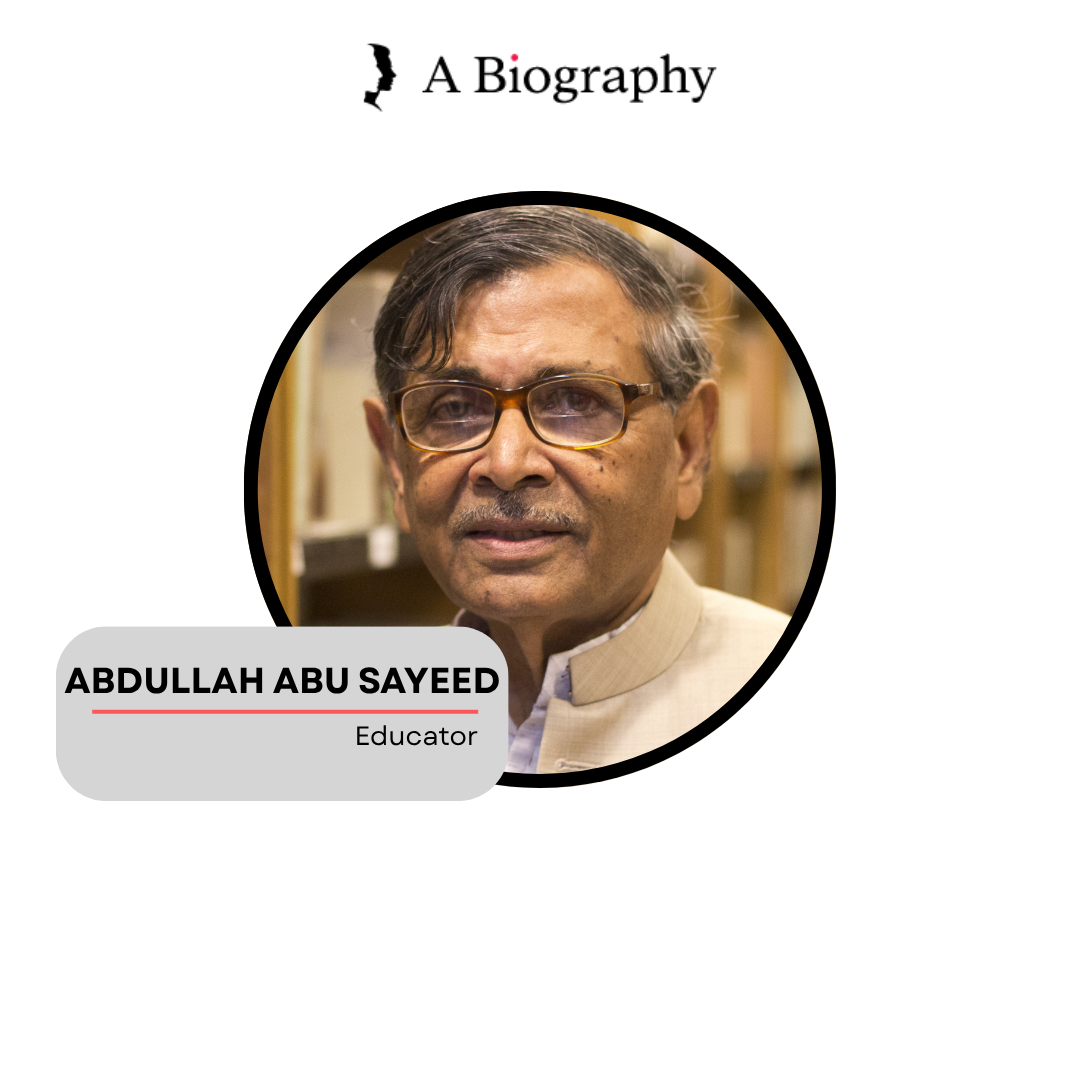
A BIOGRAPHY OF ABDULLAH ABU SAYEED

Summary
Abdullah Abu Sayeed is a celebrated educationist, writer, socio-cultural personality, philanthropist, and environmentalist of Bangladesh. He is best remembered as the initiator of the Bishwo Shahitto Kendro or the World Literature Center in 1978 with the main objectives of inspiring the culture of reading books besides popularising progressive thoughts through reading. Due to his massive annual contributions, he has earned himself a special place in the hearts of the people of the cultural and literate society of Bangladesh. This paper is also a testimony to Sayeed’s contribution not only as a teacher and writer but also as an environmentalist as well as an enthusiast’s apostle of knowledge and intellectualism in Bangladesh. His work of establishing the concept of mobile libraries and his continuing effective engagement in the positive transformation of youth through books has been nationally and internationally recognized, and he was awarded the Ramon Magsaysay Award in 2004.
Introduction
Professor Abdullah Abu Sayeed is a versatile personality of Bangladesh whose all-round contributions to education, literature, and the environment have been remarkable. For his highly committed work for culture and intellect, Sayeed established Bishwo Shahitto Kendro, or the World Literature Centre, in 1978 as a center to encourage the youth to develop a habit of reading literature as it enlightens the minds of men. Throughout his profession as an Art Teacher, TV Host, author, and social activist, he has inspired many generations of Bangladeshi people to consider meaningfully about their society, their history and their planet. His contribution remains vivid as children keep on being encouraged to consider literature as part of their transformation process.
Life of "Abdullah Abu Sayed" at a glance:
Personal Details
➢ Full Name: Abdullah Abu Sayeed
➢ Born: July 25, 1939 (Calcutta, British India)
➢ Age: 85 (as of 2024)
➢ Nationality: Bangladeshi
➢Religion: Muslim
➢ Title: “The Light of Learning”
➢ Honors: Ramon Magsaysay Award (2004), Ekushey Padak (2005)
➢ Lives simply in Dhaka, devoted to family and students.
➢ Hobbies: Reading classical literature, gardening.
Key Contributions & Legacy
1. Bishwo Shahitto Kendro (1978)
➢ Founded to revolutionize reading culture in Bangladesh.
➢ Mobile Library Project (1998): 25 book buses reached 250+ institutions, serving 500,000+ readers.
2. Literary & Cultural Influence
➢Hosted Shaptabarna (BTV, 1970s) – pioneering literary TV program.
➢ Authored 50+ books, including:
–Bhalobashar Shampan (2007)
–Amar Uposthapok Jibon (2008) – Autobiography
3. Environmental Crusades
➢ Campaigned to save Bangladesh’s rivers from pollution.
➢ Advised government on ecological policies.
Early Life & Education
➢ Migrated to East Pakistan (now Bangladesh) post-Partition.
➢ Education:
-MA in Bengali Literature (University of Dhaka)
-Edited Kanthashar magazine as a student.
Awards & Recognition
➢Ramon Magsaysay Award (2004) – Asia’s Nobel equivalent.
➢Ekushey Padak (2005) – For literature & education.
➢Bangla Academy Literary Award (2011).
Philosophy & Leadership
➢ Motto: “Books are the oxygen of a nation’s soul.”
➢Mentored generations of writers and activists.
➢ Traits:
-Meticulous – Spent hours perfecting a single sentence.
-Witty – Used humor to spark social change.
Early Life and Background
Abdullah Abu Sayeed was born on 25 th July 1939 in Calcutta, India. His father’s name was Azimuddin Ahmed. He was born in a classically Bengalised family which was intelligently associated with the rich cultural pursuits of the Bengalis. Kolkata was the birthplace of Sayeed before he finally shifted to Bangladesh with his family at a very young age. His school education started in Pabana Zilla School where he passed SSC in 1955. Sayeed next proceeded to Profollo Chandra College for his HSC examination which he passed in 1957.
Sayeed took his BA and MA in Bengali from Dhaka University because of his deep-rooted interest in Bengali literature. As a university student, he started gaining knowledge in the field of literature and culture of Bangladesh. He fell deeply in love with literature and joined this more intellectual hemisphere of society. As for literature, Sayeed was a regular reader of books and was actively involved with the culture and art societies in Dhaka during the 1960s and 1970s.
I have mentioned earlier that at the beginning of his career, Sayeed was the editor of a renowned literary magazine ‘Kanthashar.’ He was preoccupied with literature, experimenting with its magic at this stage of his life, and it is pretty apparent that he was a very literate man. At this time in his life, Sayeed’s endeavor into the realm of literature was only being established for the young man. Still, the passion for the subsequent intellectual and cultural development of his nation would persist throughout the remainder of his life.
Contributions
Abdullah Abu Sayeed has significantly contributed through social services, one of which was the establishment of Bishwo Shahitto Kendro (BSK) in 1978. When people started to read less and become less intellectual, Sayeed wanted to recuperate the passion for literature and the positive results it produced. BSK’s vision is to encourage young people to read good literature and stimulate their thoughts on liberal change.
The 1970s defined Sayeed as the host of Shaptabarna (Seven Colours) on Bangladesh Television (BTV). This program was about Bengali culture and literature and turned into a helpful way to enjoy thoughtful talks about philosophies and social values. He was also appreciated for his capacity to expound so many ideas so simply; he became an icon or an influential, moral youth icon.
A unique scheme implemented under Sayeed’s leadership was the mobile library scheme, started in 1998. Under this scheme, mobile libraries serving different educational institutions were bought with the assistance of the Norwegian government. Twenty-five buses filled with books made more than 250 stops in four big cities and literature was delivered to people with few reading options. This program vastly increased literacy and enhanced the mental diet of many thousands.
Sayeed also wrote and compiled more than fifty books on essays, short stories, and cultural commentaries. He described only literature’s transforming ability and gave many youths their first glimpses of Bengali literature.
Apart from literature, Sayeed was an environmental conservationist. When the people of Bangladesh did not take the call for protecting rivers and natural resources seriously, he came up with a message passed well about the harms of pollution and encroachments on waterways. He was a government committee member dealing with or relating to these ghastly matters – significant as a pioneer of environmentalism.
In Bangladesh, Sayeed has established a broad legacy in literature, education for the disadvantaged, and environmental conservation.
Achievements
Abdullah Abu Sayeed has made immense contributions culturally, educationally, and environmentally in Bangladesh, and his work has been rewarded nationally and internationally. He won the Ramon Magsaysay Award in 2004; it is considered to be the Asian version of the Nobel Prize. The award honored him for exploring solution-based stories in Bangladesh with Bishwo Shahitto Kendro and the mobile library concept.
Sayeed was also awarded the National Television Award in 1977 in recognition of his services in television broadcasting. In 2005, the government of Bangladesh honored him with the Ekushey Padak for his prominent contributions to literature and education. In 2011, he received the prestigious Bangla Academy Literary Award, which elevated him to the pedestal of revered academics in Bangladesh.
Sayeed’s everyday work has not solely confined itself to the borders of his country; his work extends beyond Bangladesh. Due to his commitment to education, culture, and ecology, he has gained respect in the international community. His appeal to save literature and the environment has encouraged his audience to act in their nations and countries.
Personal Life
Sayeed can be regarded as rather unassuming and austere; he is still well-mannered and does not take himself too seriously – all of which is clearly seen by the people who know him. He is a very self analyzing person who has within him a passion to bring out change in society. But despite all that, Sayeed has always kept both his feet on the ground and stays hard working and dedicated to his job, not looking forward to getting fame.
Another aspect is his friendly and cheerful disposition to a job that has earned him admiration from fellow professionals and students, as well as the general public. Only education and literature are valued by Sayeed in the same as he values his family and his close friends. He has been very keen on the need to foster the young ones’ mental and emotional health so that they may see learning as a process that comes from books as well as from real life.
Unknown Facts
➢Sayeed is renowned for his patience and dedication to nurturing and mentoring young people who seek his guidance.
➢He is legendary for his precision. He often spends hours reviewing a single letter to ensure every word is perfect before signing it.
➢His dedication to high standards reflects his belief in the importance of maintaining quality in every task he undertakes.
➢Sayeed is known for his dry wit. He often uses humor to diffuse tense situations and bring joy to those around him.
➢He famously remarked, “Civil society is like a Royal Bengal Tiger. One member is good enough,” emphasizing his faith in the power of individual contributions to drive change.
Legacy and Continuing Influence
To date, Abdullah Abu Sayeed is still alive and active in ensuring that many other individuals come along with a vision of creating a better society. These individuals reflect his contributions to the literature, education, and environment that are so important for Bangladesh. His efforts are clearly reflected in the functioning of Bishwo Shahitto Kendro, and his innumerable books will not cease to influence the future of Bangladesh.
Bibliography
Some of the notable works of Sayeed are:
➢Bidaye, Obonti (2005)
➢Bohe Joloboti Dhara (2006)
➢Bhalobashar Shampan (2007)
➢Bishwo Shahitto Kendro O Ami (2007)
➢Bisrosto Journal (2007)
➢Amar Uposthapok Jibon (2008)
➢Amar Ashabad (2009)
➢Mrityumoy O Chiraharit
➢Swapna-Duhswapner Galpo
➢Rodanruposhi
➢Juddhajatra
➢Sangathan O Bangali
➢Amar Ashabad
➢Amar Boka Shoishob (2010)
Conclusion
Abdullah Abu Sayeed’s life proves that education, literature, and activism form a society that is much needed in any part of the world. This man and his initiatives, such as Bishwo Shahitto Kendro Mobile Library’s commitment to enlightening initiatives, make him quite an influential figure in Bangladesh. He has brought a positive cultural contribution not only in the means of art but also he has played his part in inspiring people for the further development of the movement that, in fact, has sparked people’s curiosity and has also inspired individuals to think and act more responsibly toward the environment.
The success stories are encouraging to the people who wish to bring change to society and the world, and his passion to support humanity will never end. Perhaps Abdullah Abu Sayeed’s legacy is his light in lives that still adhere to the idea of knowledge, values, cultures, and protection of nature. In an era marked by cynical pragmatism, selfish consumerism, and utter disdain for the planet’s future, his bequest is a love of books and the natural world and a duty to the earth.
References
1.https://en.wikipedia.org/wiki/Abdullah_Abu_Sayeed
2.https://thefinancialexpress.com.bd/views/reviews/abdullah-abu-sayeed-spreading-the-light-of-learning-1659710562
3.https://www.thedailystar.net/opinion/views/news/celebrating-abdullah-abu-sayeed-pursuer-change-3378166
4.https://www.apaseninernational.org.uk/an-afternoon-with-professor-abdullah-abu-sayeed/
Disclaimer
All content on this website is provided in good faith and only for general information purposes. A Biography makes no guarantees regarding the information’s completeness, reliability, or correctness. Any action you take as a result of the material on this website is entirely at your own risk. A Biography is not responsible for any losses or damages incurred as a result of using our website

