
Biography
A Biography of Shahidullah Kaiser

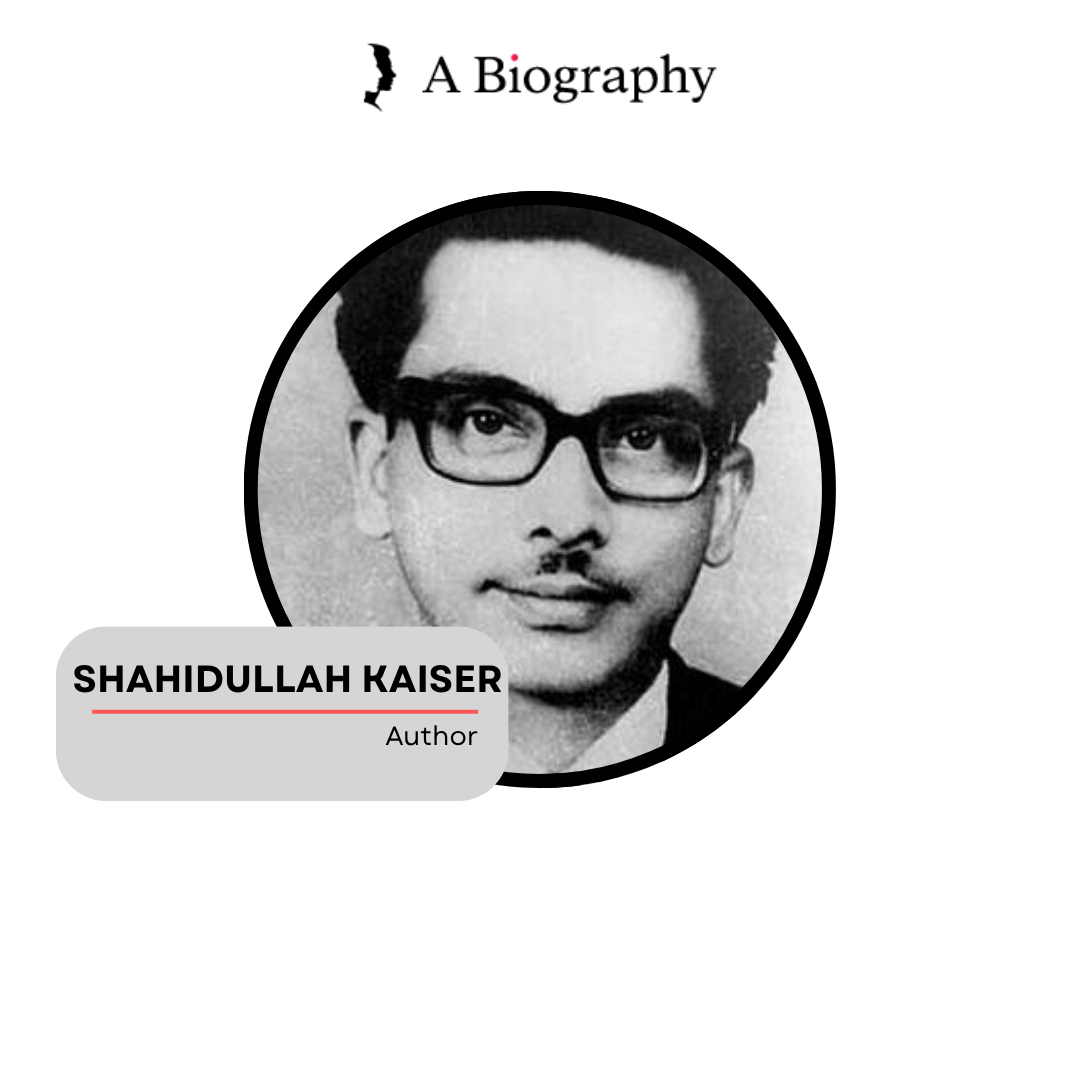
Biography of Shahidullah Kaiser
Author
(1927 – 19971)
Table of Contents
ToggleSummary
An influential Bangladeshi journalist, novelist and political activist, Shahidullah Kaiser garnered his stature from hard hitting journalism and his pebbly political crusades in the bygones of Bangladesh’s struggle.A millennium intellectual of Bangladesh, Shahidullah was recognised for his contributions in the field of literature, journalism and activism. He was known for his empathy, and for piercing insight into the struggles, the resilience and the hopes of the Bengalis on the page. Shahidullah Kaiser’s life and his legacy were commemorated with the Ekushey Padak and Independence Award posthumously. His life and ideas live on, as symbols persisting of the continuing power of both words and ideas in the quest for justice.
Introduction
Shahidullah Kaiser’s position in Bangladesh’s cultural and political history is not only due to his literary work, but also to his unswerving support for matters of social justice. He was a journalist and a writer who had described the miseries of East Pakistan (now Bangladesh) as it came to be in its formative days — the misery of poverty, persecution and inequalities. A blend of literature and activism, artistry and a dogged insistence on justice, Shahidullah’s life and work touched on the knotty issue of social injustice. But his novels and his journalistic pieces aren’t just literary works, they are historical documents that carry the voices of oppressed people struggling in order to be free. An intellectual who personified the literary new change and who stands as legacy of his era.
Life of “Shahidullah Kaiser” at a Glance
Personal Details
➢ Full Name: Abu Nayeem Mohammad Shahidullah (Shahidullah Kaiser)
➢ Date of Birth: 1927
➢ Birth Place: Mazupur, Feni, East Bengal (now Bangladesh)
➢ Died: 14 December 1971 (aged ~44)
➢ Cause of Death: Executed by Pakistani forces during the Martyred Intellectuals Massacre
➢ Burial Site: Unknown (body never recovered)
➢ Father: Not widely documented
➢ Mother: Not widely documented
➢ Religion: Islam
➢ Nationality: Bangladeshi
➢ Married to Panna Kaiser (writer & politician)
➢ Children: 2 children
-Shomi Kaiser (eldest, daughter)(famous actress)
-Amitav Kaiser (younger, son)
Education
➢ Early Schooling: Local schools in Feni
➢ Higher Education:
-BA in Economics – Presidency College, Calcutta (1946).
-Attempted postgraduate studies at Calcutta University, Ripon College, and University of Dhaka (could not complete due to political activism)
Career & Contributions
➢ Journalism & Political Activism
-1948: Joined Weekly Ittefaq as a journalist
–1952: Active participant in the Bengali Language Movement – arrested and jailed for 3 years
–1958: Worked as sub-editor at Daily Sangbad – used journalism to expose Pakistani oppression
– Communist Party Member: Advocated for social justice and workers’ rights
➢ Literary Works
–Notable Novels:
1.Sareng Bou (1959) – First novel, highlighting coastal life
2.Sangsaptak – Explored social struggles
3.Krishnapakkho – Focused on marginalized communities
–Writing Style: Simple yet powerful, centered on oppression, resilience, and human struggle
Role in Bangladesh Liberation War (1971)
➢ Supported independence through writing and activism
➢ Targeted by Pakistani forces for his intellectual influence
➢ Abducted & Murdered on 14 December 1971 (just two days before Bangladesh’s victory)
Awards & Honors (Posthumous)
➢ Ekushey Padak (Bangladesh’s second-highest civilian award)
➢ Independence Award (Highest state honor)
Little-Known Facts
➢ Mentored young writers and journalists
➢ Wrote in simple Bengali to reach common people
➢ Respected across political divides for his integrity
➢ One of the first to document sailor & coastal life in Bengali literature
Death & Legacy
➢ Martyred Intellectuals Day (14 December) commemorates his sacrifice
➢ Symbolizes the Pakistani military’s attempt to cripple Bangladesh’s intellectual leadership
➢ Remembered as a voice of the oppressed and a literary pioneer
Early Life and Background
Abu Nayeem Mohammad Shahidullah, popular as Shahidullah Kaiser was born in 1927, in the village of Mazupur (Feni Township district) in East Pakistan (present day Bangladesh). There was a tremendous role of his family in developing his viewpoint, giving him his intellectual curiosity and empathy and also responsibility for the society. Coming from a very large family with seven siblings, shahidullah grew up with resilience and an insight of people from all classes of life.
Shahidullah doubtless began his education in Feni, where he shone quickly while studying, making a name for himself. With an obvious eagerness to broaden his horizons, he enrolled in the establishment of Presidency College in Calcutta, taking a degree in economics, graduating in 1946. At Presidency college, he had come into contact with a variety of ideas and perspectives and his new way of thinking was broadened. Nevertheless, it was hard for him to pursue further education. He tried but failed to carry his postgraduate studies in institutions like Calcutta University, Ripon College, and University of Dhaka on account of his personal and political reasons. This experience would shape his mindset, which would resonate with his writing later.
Contributions
Shahidullah joined Weekly Ittefaq as a journalist in 1948. He also joined the Communist Party of Pakistan around this time because his ideals were social equality and justice. It was a feature of his life that he believed in the Communist ideology and made a steadfast effort for the well being of the masses. An important part of the campaign for Bengali identity was the 1952 Bengali Language Movement, which he participated in. Shahidullah supported the movement and was arrested and then sentenced to three years in prison. It was a turning point in his life and his pledge to serve the Bengali nationalist cause ratchets up a notch.
After his release in 1955 Shahidullah returned to his journalistic vocation, becoming a sub-editor at the Daily Sangbad in 1958. This placed him in a position to get to a wider readership and see his work on the problems of East Pakistan. He was also arrested again the same year for political activities. His time in prison helped reflect and create his resolve. While still in prison, he wrote fiction from which he got his first novel, Sareng Bou. The subject of coastal life and experiences of sailors had seldom been dealt with in Bengali literature before. His inspiration was his vivid and intensely empathetic portrait of the marginalized, readers saw him as a powerful new voice in Bengali literature.
Shahidullah went on to pen some more literature like Sangsaptak, Krishnapokkho; which discussed the life of normal people in terms of their social structures, poverty and strength to continue living their lives. His stories usually centered on a struggle for survival in an unfair and unequal society, voicelessly addressing the oppressed and brightening the naked human spirit. His writing style was simple and direct, however, his way with words gave him the means to express something complex in simpler terms. Despite his early death, he was an important part of Bengali literature, someone who graced the language with his literary works.
Journalism and Political Activism
Apart from his literary work, Shahidullah’s career as a journalist provided him the opportunity to interact with the modern day issues face to face. Often critiquing oppressive policies of the Pakistani government and highlighting the economic and social problems confronting people in East Pakistan, his journalistic pieces were a way for him to be the ‘voice of the people’ in the face of the appalling neglect of that nation by the Pakistani establishment. Unapologetically bold and challenging the status quo, his writing in the Daily Sangbad emphasized political as well as social reforms. As a journalist, he was an important means to bring to the surface the people of Bengal’s right and identity – hence became a target of government crackdown.
His political activism had gone beyond journalism. Shahidullah’s part in the Communist Party and Bengali Language Movement displayed his readiness to shed light to his ideals at the cost of personal life. He cared deeply about the well being of his fellow citizens, even if it put him at risk while challenging the worst policies for those citizens. He was a man of his word, someone who stuck to his beliefs, someone who was excellently respected within his peers, and was an influential and resounding force within East Pakistan’s political landscape.
Literary Style
Shahidullah Kaiser’s literary style is simple, clear and somewhat unpretentiously straightforward. Most of the time, he would write about regular characters, taking names from people he met in his life. Often his works deal with social injustice, resilience, and human capacity to empathy. Shahidullah’s interest in the marginalized communities was a result of his personal faith in giving a voice to those that do not get heard.
In Sareng Bou he looked at the lives of sailors and coastal communities, their hardships, and their fierce stoicism. The realization of a social group that hardly features in Bengali literature in any form was a breakthrough in the novel. After that, his subsequent novels and stories elaborated on the misadventures of common folks, and his facile manner of experiencing human experience. Shahidullah wrote with strong and vulnerable characters, the empathy being profound. By taking this empathetic approach, his readers could relate with his stories so deeply, they are forever popular and relevant.
Awards and Achievements
Shahidullah Kaisar’s contribution to Bengali language was immense despite being a relatively short spanning career. He won many prestigious honors. He was posthumously given the country’s highest civilian honor, Ekushey Padak, for his contribution to literature and journalism. For leading in the cause for Bengali culture and his sacrifice in the country’s Liberation (of Bangladesh from Pakistan) War, he was also given the country’s top state award, Independence Award. This is a recognition of the fact that the literature of Bengali, in which he wrote, continued to be influenced after his death. Also his bringing to Bengali literature its authentic elements and his invaluable contribution for the attainment of national identity and freedom are widely recognised.
Personal Life
In 1969 Shahidullah married Panna Kaiser, also a writer and, later, a politician. They had a mutual respect and shared values, also they both had committed to the social justice and cultural preservation causes. Shomi Kaiser and Amitav Kaiser were the couple’s two children. Shomi did not, however, follow in Panna’s footsteps instead building a successful career in acting and became an important figure in Bangladeshi entertainment industry while Panna added flames to Shahidullah’s legacy by being a part of literature and politics.
Shahidullah’s children and widow show that a family inspiration of ideals of equality, justice, and service to society drove the Kaisers. It was Panna Kaiser’s work that helped ensure that her husband’s memory is kept alive as well as preserved his contributions to Bengali culture. As a writer and a political figure she had kept Shahidullah’s legacy alive for generations to come.
Unknown Facts
➢ Shahidullah’s perseverance in education showed his deep commitment to knowledge.
➢ He was a mentor who inspired young writers to pursue impactful journalism.
➢ His guidance helped shape a new generation of socially conscious writers.
➢ Shahidullah’s simple language made his writing accessible to the common people.
➢ His empathy allowed him to portray marginalized lives with depth.
➢ He was respected for maintaining friendships across ideological divides.
Death
Shahidullah Kaiser’s death is one of the most darkening chapters in Bangladesh’s history. Shahidullah was taken from his home on December 14, 1971 – just days before Bangladesh was to become independent – by Pakistani forces and local collaborators. He became a martyr in the Martyred Intellectuals massacre, a ghastly and deliberate attempt by the Pakistani army to obliterate the very brightest brains of a fledgling baby nation Bangladesh. He was never found, and his loved one’s family was left with the soul sucking pain of his disappearance.
Martyred Intellectuals Day is observed in Bangladesh on 14 December each year to commemorate Shahidullah and other martyrs of the freedom movement. This remembrance does not simply honor these intellectuals, but to call upon all future generations to carry on their work in the quest for justice, equality and freedom. The death of a man so married to Bangladesh’s history as Shahidullah is resounded as a personal tragedy for the whole nation that has yet to fade from its cultural memory.
Conclusion
Shahidullah Kaiser’s life and works remain a living reminder that literature and journalism were—and are—all about resistance and social change. He gained respectability through his unwillingness to compromise on issues of justice, and his fearless activism, also in the manner he portrayed human struggle — an enduring symbol for the Bengali people’s fight for independence and dignity. His literature, novels, short stories and articles, did not only mirror the socio-political enigma of his time, but also provided food for thought and inspired them to pursue truth and equality in future generations. Shahidullah Kaiser’s legacy lives on, having died untimely at the hands of the Pakistan Army, but there is a lesson here: justice, freedom and the right to hear the voice of the ones that have none.
References
1. The Daily Star. (2016, January 15). The mad genius: Shahidullah Kaiser. https://www.thedailystar.net/star-weekend/mad-genius/shahidullah-kaiser-660601
2. Alam, Muhammad Shamsul (2012). “Shahidullah Kaiser”. In Islam, Sirajul; Jamal, Ahmed A. (eds.). Banglapedia: National Encyclopedia of Bangladesh (Second ed.). Asiatic Society of Bangladesh.
3. “Independence Day Award” (PDF). Government of Bangladesh. Retrieved 23 September 201.
Disclaimer :
All content on this website is provided in good faith and only for general information purposes. A Biography makes no guarantees regarding the information’s completeness, reliability, or correctness. Any action you take as a result of the material on this website is entirely at your own risk. A Biography is not responsible for any losses or damages incurred as a result of using our website.

