
Biography
A BIOGRAPHY OF TAREQUE MASUD

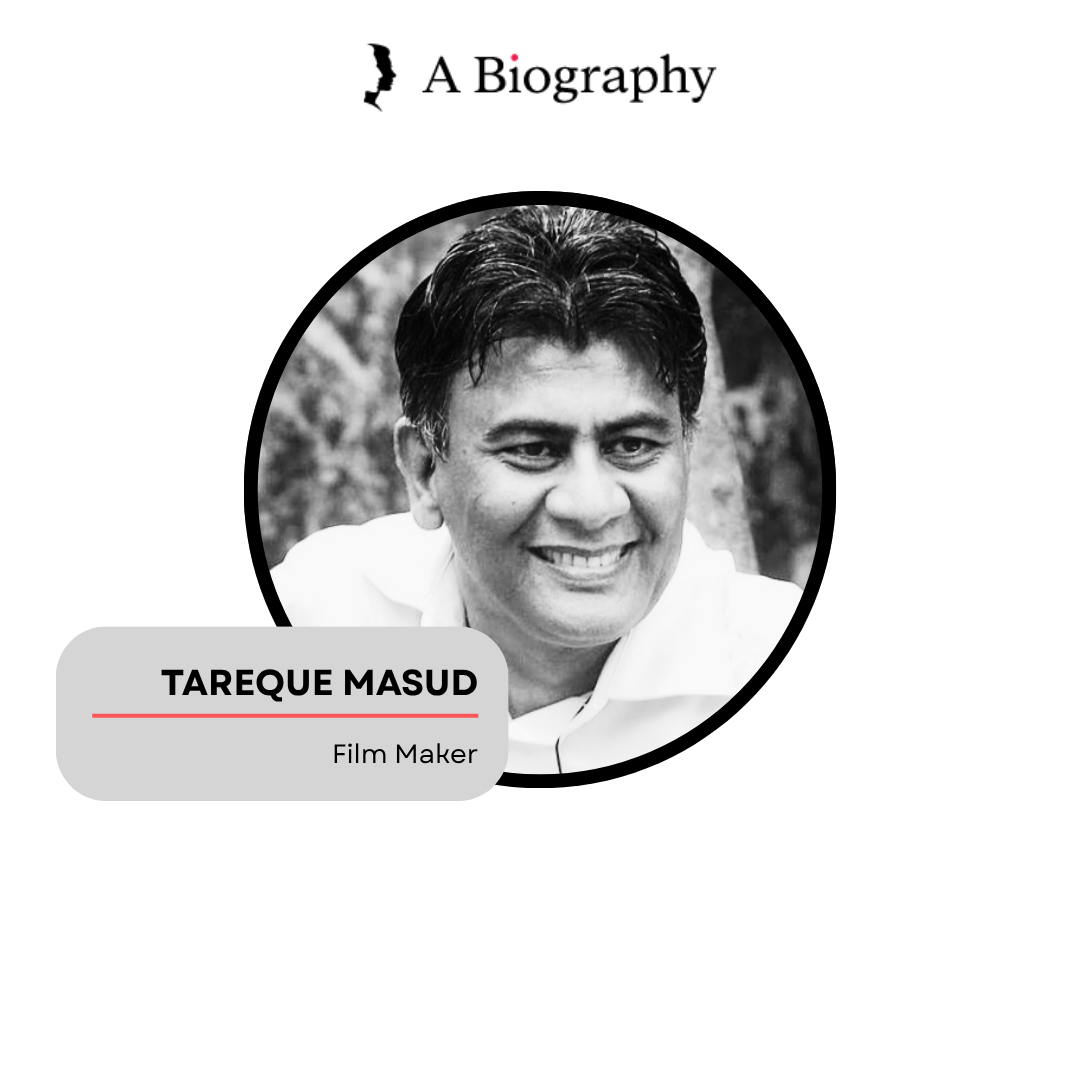
Table of Contents
ToggleBiography on Tareque Masud
Bangladeshi Film Maker
(6 December 1956 – 13 August 2011)
Summary
Today let’s know the story of a “cinema peddler.” In Bangladesh, he made films to raise the country to new heights. Through his work, biographical and documentary films were introduced in Bangladesh, revealing the nation’s true heritage, beliefs, and history. Thus he’s the pioneer of this genre of movie in the country. This filmmaker was the ‘Ekushey Padak’ award-winner Tareque Masud.
Born in 1956 in a Faridpur village, Tareque began his education in a madrasa. Who knew this boy would someday shine both in Bangladesh and globally? His vision was just as exceptional.
After earning a degree in history from Dhaka University, he decided to pursue ‘filmmaking’. His films held Bangladeshi historical stories. Although he couldn’t watch many films in his childhood, after watching Satyajit Ray’s “Pather Panchali”, he was inspired to make films in the similar style. Tareque achieved success with his films on the Liberation War, but “Matir Moyna” truly marked his talent. This film won the Cannes award in 2002, becoming the first ever Bangladeshi film to receive this prestigious award. His films often had themes of strong patriotism, women’s empowerment, and social-cultural traditions.
The characters in his films were reflections of his own personal life. He always conducted thorough research before making a film. In 1988, he married an American-born, Catherine Masud, and they spent their married life creating several films together.
Unfortunately, Bangladesh’s cinematic chapter and Tareque’s life ended shortly in a tragic road accident in 2011 at the age of 54. He left his final film, “Kagojer Phool” incomplete. Although Bangladesh lost such a gem, his legacy still lives on us through his work. His wife still continues to preserve and spread his legacies. Now, it’s our duty to keep his legacy alive, and carry forward his dreams to take Bangladeshi cinema to the international eyes.
Introduction
“Matir Moyna” and “Cinema Feriwala” – these 2 terms are enough to understand who the referred person is. He can be considered as the pioneer filmmakers in Bangladesh who started working and taking documentary films to international audiences. Because of him, Bangladeshi films received several global recognitions, even won the Cannes award. Interestingly, he was a madrasa-going student in his young life, but had a different life vision than we typically think about them. He was none other than the eminent “Ekushe Padak” winner Tareque Masud.
Life of "Tareque Masud" at a Glance
Personal Details
➢ Full Name: Tareque Masud (born Abu Tareque Masud)
➢ Date of Birth: 6 December 1956
➢ Birth Place: Nurpur Village, Bhanga Upazila, Faridpur District, East Pakistan (now Bangladesh)
➢ Died: 13 August 2011 (aged 54)
➢ Cause of Death: Road accident on Dhaka-Aricha highway
➢ Resting Place: Nurpur, Bhanga, Faridpur
➢ Spouse: Catherine Masud (m. 1988)
➢ Children: One son, Nishad Bingham Putra Masud
➢ Nickname: “Cinema Feriwalla” (Vendor of Movies)
Education
➢ Early Education: Madrasah (Islamic school) for eight years until 1971
➢ Higher Secondary: Notre Dame College, Dhaka
➢University: University of Dhaka (MA in History)
Career & Contributions
➢ Pioneering Roles:
-Founding member of Bangladesh Short Film Forum (1986)
-Organized Bangladesh’s first International Short and Documentary Film Festival (1988)
-Co-founded Audiovision production house with wife Catherine
➢ Notable Films:
-Adam Surat (1989) – Documentary on painter SM Sultan
-Muktir Gaan (1995) – Liberation War documentary that became a cult classic
-Matir Moina (2002) – First Bangladeshi film to win awards at Cannes
-Runway (2010) – Exploration of religious radicalism
-Kagojer Phool – Unfinished final project about the 1947 Partition
➢ Cinematic Style:
-Blended documentary realism with artistic storytelling
-Focused on themes of religious conflict, national identity, and women’s empowerment
-Drew heavily from personal madrasah experiences and Bangladeshi folk traditions
Major Awards & Honors
➢ International Recognition:
-FIPRESCI Prize, Cannes Film Festival (2002) for Matir Moina
-First Bangladeshi film nominated for Academy Award for Best Foreign Language Film
-Best Screenplay Award, Marrakech International Film Festival (2002)
➢ National Honors:
-Ekushey Padak (2012, posthumously) – Bangladesh’s second-highest civilian award
-National Film Awards for multiple films
➢ Legacy Honors:
-Google Doodle commemorating his 62nd birthday (2018)
-North American retrospective of his films at New York University (2013)
Little-Known Facts
➢ Personal Sacrifices: Invested his life savings to complete The Clay Bird
➢ Archival Work: Rescued and restored historic footage of Bangladesh’s Liberation War
➢ International Collaboration: Worked with American filmmaker Lear Levin to preserve war documentation
➢ Humble Nature: Known for personally touring villages with mobile film projections
Early Life
The eminent filmmaker, who had given so much to the Bangladeshi cinema world, started his life on 6 December 1956 in Nurpur village of Bhanga Upazila of Faridpur district. Though not much information about his family and childhood life is known, but as admitted by himself, Tareque’s life was very similar to what was shown in his film Matir Moyna. Therefore, he had a father who was an Imam of the village masjid and he had a younger sister too.
The transition of his life from childhood to adulthood is really interesting. Thanks to his academic background, such drastic change happened in his life.
Education
Tareque Masud began his life in a Madrasa located nearby his village home. Till class 8, he continued studying there. In 1971, his education was interrupted due to the 9 month Liberation War of Bangladesh. After the independence of Bangladesh, he shifted to the general education line, came to Dhaka and completed his HSC from Notre Dame College. He then got admitted to University of Dhaka and obtained BA (Hons) and MA in the Department of History.
The beliefs that he obtained from studying madrasa as well as while studying in a co-ed education at the college and university, opened lots of different perspectives for him which he implied into his filmmaking journey and thus flourished his career.
Career and Filmography
During his university days, Tareque Masud was involved with the film society movement. Eventually he started working for his very first project ‘Adam Surat’ (The Inner Strength), in 1982. It was a documentary on the renowned Bangladeshi painter, SM Sultan; the journey of him being an artist to a noble man. It took 7 years to complete the project. It was a seminal work; a 54-minute episode. The language and structure needed for documentary films were established by this project. Thus, he became the pioneer creator in Bangladesh in terms of forming documentary films. In 2000, he released a similar type of film, Narir Kotha (Women and War), where he portrayed the roles of Bangladeshi women during the time of war.
His next documentary was in 1995, ‘Muktir Gaan’ (The Song of Freedom), which became a classic to a large audience. The film featured a music group singing to motivate the freedom fighters during the Liberation War of Bangladesh, in 1971. For this film, he had collected different footage of the 1971 war, shot by an American filmmaker, Lear Levin. It is reported that Levin let Tareque use the photos in the film for free! After this film, he worked for ‘Muktir Kotha’ (Words of Freedom) from 1996. In 1999, he released the movie. For this, he travelled the whole Bangladesh, gathering war stories from the rural people. He was passionate to have authenticity in his films.
His first full-length feature film, the internationally recognized ‘Matir Moyna’ (The Clay Bird), was released in 2002. It was the maiden movie that had brought Bangladesh the Cannes award and thus it was the most globally discussed Bangladeshi film ever. The movie was heavily inspired and extracted from Tareque’s own life, but made in the context of the 1971 war of Bangladesh; how the lives of Bangladeshis in the 60s paved ways for the 71’s war. His intention was to portray the real inside life of a madrasa-student, as an insider himself. The title of the film was taken from his own childhood event, when he once brought a clay bird for his sister. Tareque admitted that he had taken inspiration for this film from Satyajit Ray’s renowned movie ‘Pather Panchali’. At the time of his death, Tareque was working for the film ‘Kagojer Phool’ (the Paper Flower), which was supposed to be a prequel for Matir Moyna as it was about the partition of the Indian subcontinent in 1947.
His other famous works include: A Kind of Childhood in 2002, Ontarjatra in 2006, Naroshundor (The Barbershop) in 2009, and Runway in 2010.
Besides his filmmaking projects, he also served as the founding member of Bangladesh Short Film Forum in 1986. It is a leading platform for independent Bangladeshi filmmakers.
In all his movies, he tried to keep the same recurring themes and casting members. His themes were mainly religious conflicts, questions about freedom, Bangladeshi rural culture and beliefs, strong female characters and patriot characters. His films and services were direct reflections from his personal life.
Personal Life
Tareque was a fearless person who wasn’t afraid to give voice to the voiceless, marginalized, and minority people whose stories are usually kept hidden from the media. He used to do deep research before presenting something. While staying in the USA, he had worked at a bookstore which helped him gain lots of knowledge. Whatever he did, was purely from his heart. He stayed true to his culture and roots.
In his personal life, he was humble and down to earth. When he first brought his 6-months old son from the US to his village home, he put the baby on the muddy-ground so that the baby could experience childhood like the father. Tareque himself worked hard to raise funds for his films and also helped his friends in monetary need. Because of his kindness and humbleness, he was always loved, admired, and respected by all.
In marital life, Tareque was married to an American film editor, Catherine Lucretia Shapere. The 2 first met in the late 1980s when Catherine had come to Dhaka for research work. She had a keen interest for films and arts and thus became Tareque’s friend. Later, in 1988, they got married and she took the name Catherine Masud. She then joined her husband in the filmmaking journey. Since 1995 till now, she has been living in Dhaka. Both of them equally contributed to the films. They were known to be a ‘Happy couple’ among their friends. They had a son, Nishad Bingham Putra Masud, 21 years after their marriage. They used to take their baby everywhere they went, even in the shooting spots. But on the day of Tareque’s death, they left their 15-month old baby at home.
Death
It was on 13 August, 2011, when the film production unit of Tareque Masud along with his wife and other members were travelling by a microbus to the Manikganj town. The journey was to meet the then Manikganj’s deputy commissioner for granting permission to shoot for their latest project “Kagojer Phool”. They had just visited a shooting spot in Shibalaya upazila of Manikganj district for the project. However, soon all of their dreams got shattered forever.
On the Dhaka-Aricha highway at Ghior upazila of Manikganj district, the microbus suddenly crashed head-on with a bus coming from the opposite direction at a high speed. It was raining heavily at that time and hardly anything was visible in front. There was no road divider too in that highway. The result of the clash was Tareque Masud, the then famous media personality and the CEO of ATN News Mishuk Munier, the driver and 2 others instantly lost their lives. Catherine, renowned painter Dhali Al Mamun, his wife, and a film production staff survived with heavy injuries. They were trying to crawl out of the damaged microbus, so the locals rescued and immediately took them to Manikganj Sadar Hospital. Later they were shifted to Dhaka’s Square Hospital for better treatment.
With this accident, Bangladesh had lost a gem like Tareque Masud, only at the age of 54 years.
The dead bodies were kept at the mortuary of Bangabandhu Sheikh Mujib Medical University and next day they were taken to the central Shaheed Minar at 10:30 am for the common people to pay their last tribute. The then President Zillur Rahman, former Prime Minister Sheikh Hasina, Leader of the former opposition party Khaleda Zia, and leaders of other socio-cultural parties expressed deep shock at this tragic death. One year later, his family filed a case in the high court and 5 years later, the court ordered Tk 4.61 crore to be paid as compensation to his family.
Tareque Masud was later buried at his family graveyard in his village home in Faridpur district. With this burial, it felt like a chapter in the futuristic Bangladesh’s cinematic identity had ended. But, his wife kept his legacy still ongoing to bring Bangladeshi cinemas to the national and global level.
Legacy
Since the death of her beloved husband, Catherine has been working hard to re-releasing their older projects on DVD and is editing biographical books of Tareque. In 2012, she had opened a non-profit organization ‘Tareque Masud Memorial Trust’ (TMMT), in order to preserve and promote his legacies and philosophies. Every year from 2013, TMMT collaborates with Moviana Film Society and organizes ‘Tareque Masud Memorial Lecture’ where the country’s well-known cultural figures or academics speak on cinema related topics. Furthermore, TMMT arranges different arts festivals and film competitions to encourage new enthusiastic media personnel to work in these fields. The winners of these events get cash prizes and scholarship opportunities to study films at Pathshala South Asian Media Institute, Dhaka.
On 6 December 2018, in honor of his 62nd birthday, a Google Doodle was displayed on Google Bangladesh page. This shows his international recognition which still prevailed even after many years to his death.
Awards and Achievements
Through his amazing and notable works, Tareque Masud had represented Bangladesh’s name and image to international eyes.
For the film ‘Muktir Gaan’, he earned the ‘Best Film’ award from Bengal Film Journalists’ Association Awards, India, in 1996. In the same year, he received the ‘National Award’ in the documentary film category. In 1997, the film got Special Mention at the Festival of southasian documentaries at Film South Asia.
In 2002, for ‘Muktir Kotha’, he got the award as ‘Best Narrative Documentary’ at the Three Continents Festival, France. In the same year, ‘A Kind of Childhood’ film was awarded the ‘Jury Prize’ at the International Video Festival, India. In 2006, the film ‘Ontorjatra’ got an award under the ‘Best Direction’ category at the International Film Festival, Bangladesh, and also it earned the ‘Special Jury Award’ at the Osian’s Cinefan Festival of Asian and Arab Cinema. For the last film of Tareque, in 2010, ‘Runway’ received ‘Meril Prothom Alo Awards’ under the Best Film category.
The most acclaimed film Matir Moyna received the highest numbers of international recognitions and awards. It won the “International Critics’ FIPRESCI” prize, in the Directors’ Fortnight section, at the 2002 Cannes Film Festival held in France. It also received the “Best Screenplay Award” at the International Film Festival of Marrakech, Morocco, 27th Bangladesh National Film Awards, in 2004, and at the 33rd Bachsas Awards, Bangladesh. Under the ‘Best Featured Film’ category, it got awards from 3 different events; Bengal Film Journalists’ Association Awards, India, Kara Film Festival, Pakistan in 2003, and Channel I Film Awards, Bangladesh, in 2003. The film got 2 more ‘Bachsas Awards’; one for ‘Best Director’ and for ‘Best Story’ category.
In 2012, posthumously, he achieved the ‘Ekushey Padak’, which is the highest civilian award of Bangladesh. Additionally, in 2013, in honor of him, New York University Asian/Pacific/American Institute, and South Asia Solidarity Initiative, hosted the first North American retrospective of his films.
Conclusion
Tareque Masud’s influence and contributions to our film industry is impossible to deny. Though he had left us, but kept behind some beautiful visionary paths and by following those, the newcomers can take Bangladesh again to the global peak. If we can capture the true culture and essence of our country, just like how authentic and relatable Tareque’s cinematic journey was, we might someday see Bangladeshi cinemas as famous as Hollywood or Bollywood movies.
Reference
1.https://en.wikipedia.org/wiki/Tareque_Masud
2.https://www.thedailystar.net/news-detail-198549
3.https://www.catherinemasud.com/tmmt
4.https://en.wikipedia.org/wiki/Catherine_Masud
5.https://www.newagebd.net/article/131923/adam-surat-the-seminal-creation-of-tareque-masud
6.https://www.thedailystar.net/news-detail-198565
7.https://asiasociety.org/interview-tareque-masud-director-clay-bird
Disclaimer
All content on this website is provided in good faith and only for general information purposes. A Biography makes no guarantees regarding the information’s completeness, reliability, or correctness. Any action you take as a result of the material on this website is entirely at your own risk. A Biography is not responsible for any losses or damages incurred as a result of using our website.

