
Biography
A BIOGRAPHY OF MICHAEL MADHUSUDAN DUTT

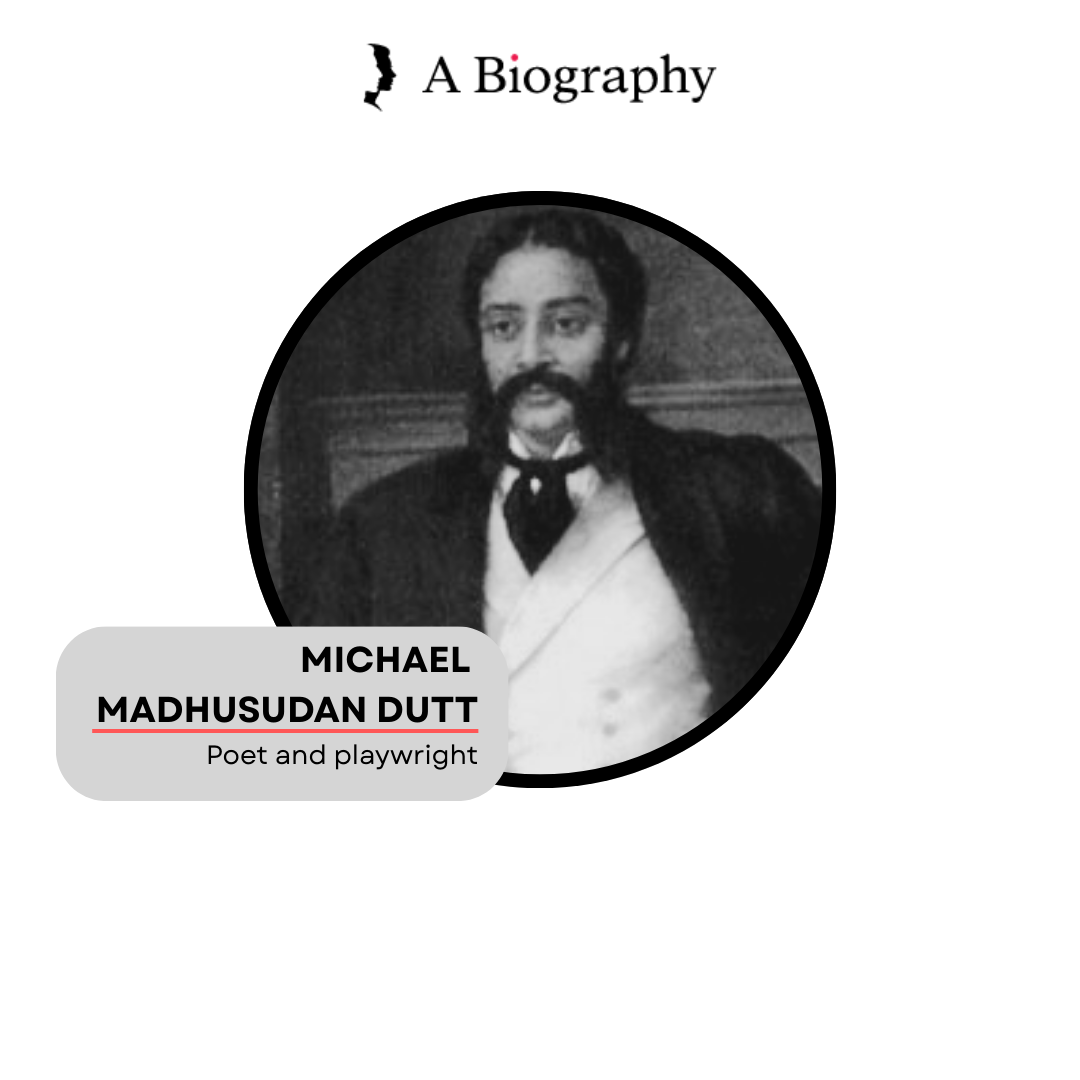
Biography on Michael Madhusudan Dutt
Poet and playwright
(25 January 1824 – 29 June 1873)
Summary
Imagine the young man, with dreams and aspirations to become a literary person, at a crossroads of two different worlds. One foot in the tradition of Bengali ancient culture with the other one foot set firmly into the intoxicating and foreign arms of Western ideas and literature. The soul of Michael Madhusudan Dutt’s life is a marked friction between cultural identities and intellectual revolutions.
Madhusudan was born on January 25, 1824, in a quiet village in Silaidaha (now in Bangladesh), thereby growing up in India when India was under British rule, a society between the past and future. The conservative Brahmin boy was little known to the world, and this boy was one of the most influential poets in Bengali book writing who would go on to transform it.
Introduction
Imagine a young boy belonging to the minority group of the country, who became a lawyer first and eventually got the role of the Chief of Justice of Bangladesh. Not many can even dream of having such a drastic change in life. Starting with a humble beginning, his life and career met with numerous drama. Ultimately, the drama ended after he stepped down from the position and left the country. It was 11 years ago that this man’s name echoed in everyone’s mouth, but due to various types of controversies. Yet, he is still a popular former lawyer as because of his strong dedication towards judiciary and mental strength, many new/future lawyers aspire to be like him. He is Surendra Kumar Sinha, commonly known as SK Sinha.
Life of “Michael Madhusudan Dutt” at a Glance
Personal Details
➢ Full Name: Michael Madhusudan Dutt (born Madhusudan Datta)
➢ Date of Birth: 25 January 1824
➢ Birth Place: Sagardari, Jessore District, Bengal Presidency (present-day Bangladesh)
➢ Died: 29 June 1873 (Aged 49)
➢ Religion: Christianity (Converted from Hinduism in 1843)
➢ Nationality: British Indian
➢ Family: Son of Rajnarayan Dutt and Jahnabi Devi. Married Rebecca Thompson McTavish (1848); had a lifelong partnership with Emilia Henrietta Sophie White.
Education
➢ Early & Home: Initial education in Bengali, Persian, and Arabic; tutored by his mother and a local maulavi.
➢ School: Hindu College (now Presidency University), Kolkata. Mastered English and studied Western literature.
➢ University: Bishop’s College, Shibpur (after conversion).
Literary Career & Milestones
➢ Early Work & Conversion:
-Wrote early poetry and essays in English, inspired by Romantic poets like Byron.
-His conversion to Christianity (1843) was a defiant act of embracing Western identity, leading to social estrangement.
➢ Pioneering Innovations in Bengali:
-Introduced blank verse (amitrakshar chhanda) to Bengali poetry, liberating it from rigid rhythmic structures.
-Credited with inventing the Bengali sonnet (chaturdashpadi), adapting the 14-line form to the language.
-Revolutionized Bengali drama by blending Sanskrit epic themes with Western tragic structure.
➢ Major Works:
-Meghnad Badh Kavya (1861): His magnum opus, an epic poem recasting the Ramayana from Ravana’s perspective.
-Sharmistha (1859): The first modern Bengali play based on a Sanskrit epic.
-Kapatakkha Nad: A famous sonnet expressing longing for his homeland.
Personal Struggles & Identity
➢ Cultural Conflict: Lived perpetually torn between his deep Bengali roots and an all-consuming fascination with Western culture and Christianity.
➢ Financial & Personal Hardship: Despite literary fame, he suffered chronic financial distress and lived in debt for most of his life.
➢ Exile & Return: Lived in Europe (England and France) for several years, working as a clerk. Returned to Bengal in 1856, where he composed his most famous works.
➢ Final Years: Died in Calcutta in poverty and poor health, three days after writing his final poignant letter.
Publications (Major Works)
➢ Epic Poetry: Meghnad Badh Kavya (The Saga of Meghnad’s Death)
➢ Plays: Sharmistha, Krishnakumari
➢ Poetry & Sonnets: Chaturdashpadi Kabitabali (Sonnets), Brajangana
➢ Early English Work: The Captive Ladie
Awards & Recognition
➢ While formal awards did not exist in his time, his genius was recognized by contemporaries like Ishwar Chandra Vidyasagar.
➢ Posthumously celebrated as a foundational figure of modern Bengali literature.
➢ Remembered annually on his birth and death anniversaries; numerous institutions, streets, and awards are named in his honor.
Legacy
➢ Regarded as the pioneer of modern Bengali poetry and drama. His formal experiments fundamentally reshaped the literary landscape.
➢ Symbolizes the creative tensions and fusions of the Bengal Renaissance—a bridge between Eastern and Western literary traditions.
➢ His life remains a powerful narrative of artistic rebellion, brilliance, and the personal cost of genius.
Early Life and Background
Madhusudan showed a strong interest in reading at an early age, but he wasn’t particularly drawn to traditional Bengali literature. The poetry of Western poets like Milton and Byron fascinated him. Consider the confusion that might result from a young child from a very religious family reading poetry whose ideas contradicted those of his community. However, this served as the cornerstone of his creative creativity. He bravely decided to go to England at the age of 16 in search of a new identity.
Here in the land of Shakespeare and Shelley Madhusudan was to metamorphose. After borrowing “Michael” he gave up his original name, “Madhusudan Dutt.” In the strictest sense, it was not just a change of name; it was an oath of allegiance to the Western literary canon and a refutation of Bengal’s traditional disciplinary boundaries. An odd step forward in this direction was his conversion to Christianity, which alienated his family and community but made him a fixture in the world of Western literature.
While in England, Madhusudan devoted his time to reading English poetry. Exposure to Western literature helped him to refine his voice, and before he could run, he began writing in English and wrote sonnets and poetry. It really began to blossom for him as a poet in Bengali when he returned to India.
Madhusudan’s Journey Toward Literary Greatness
Michael Madhusudan Dutt’s career as a literary genius wasn’t a smooth ride—it was a series of rebellions, crudities, self-discoveries, and experiments in the art. While studying at the Hindu College in Kolkata, Madhusudan exhibited himself as a young man of ambition who was eager to throw off tradition. Shaped out of his admiration for the Western poetic style and dramatic flair, he was beginning to write his shape of self.
This was one of his first bold literary experiments—he wrote in English, which was not only contrary to what most Bengali writers did but also very brave of a young Bengali writer. Madhusudan, in his early works, wrote such a poem as ‘The Captive Ladie’ showing an inclination towards Western Romanticism by imitating the style of Byron and Wordsworth. However, as he grew, he started wondering if he made the right decision by writing in English.
Madhusudan was persuaded that the native language of Bengal, Bengal, could be a worthwhile medium for the expression of profound ideas. His first written works in English served as the bedrock on which the epic, dramatic, and lyrical experiments he advanced in Bengali literature were later founded. His decision to write Bengali was not only a personal experience but a politicized experience for Bengali as a language that could compete with the global literary traditions of the 19th century.
A Revolutionary Approach to Bengali Poetry
A linguistic shift was not an end but a revolution in form and content when Madhusudan, as he did later, shifted from his native Assamese to Bengali poetry. Traditional Bengali poetry was highly structured and demanded by traditional Bengali conventions. He introduced blank verse to Bengali poetry, a style that gave it greater emotional and thematic freedom. The use of this innovation changed Bengali literature wholly and into a new era, from then on allowing the poets of future generations more contemporary themes and thought.
His use of mythological characters in modern contexts is a small example of his transformative impact. In Krishna Kumari, Madhusudan wrote about the human emotions and emotions of the divine in the same mythological forms, bringing a further layer of psychological depth to such a traditional narrative. This attempt not only made Bengali drama modern but widened the range of possible Bengali poetry.
The Bengali Sonnet: A New Form of Expression
Widely celebrated pioneer of sonnet in Bengali literature, Michael Madhusudan Dutt. The possibilities of Bengali poetry were redefined by the adaptation to the 14-line structure of the sonnet inspired by Western poets like Milton and Petrarch by Madhusudan. For his being entirely original in this work, he broke the mold and left behind a compact and lyrical mode of expression—one that marked a departure from traditional Bengali poetic forms.
Amongst the sonnets that are well-known of him is his Kapatakkha Nad (The River Kapatakkha). The poem was written in exile, the site of his longing for his homeland. The beauty of the river Madhusudan’s birthplace was brought out with vivid imagery and feeling in the poem, thus giving away and making clear that Madhusudan was linked with matter that is more obvious, his roots, and yet was Western in his affectations.
This was an innovation of first importance that set forth a type that can quite simply express complex feelings and ideas. Some of the other poets of Bengal, such as Rabindranath Tagore have used the kind of structure paved by Madhusudan’s sonnets in their work.
Personal Life: Struggles Between Identities
Madhusudan was also not just a poet but also a revolutionary of the playwright. Currently, Bengali drama is under the grip of tradition. In Sanskrit drama, Madhusudan took the risk to introduce Western theatrical traditions on the stage. Sharmistha was a turning point in relating the concept of modern drama in Bengali. Unlike traditional (ordinary) plays, his plays spoke about contemporaneous existence and portrayed real human emotions, things that traditional Bengali plays did not broach.
Madhusudan had led a life of personal contradictions. Yet he was a man torn between his Bengali heritage and its Western influences, struggling to deal with the demon of his identity. His first marriage to an Englishwoman, Henrietta, was difficult. But it was separation, betrayed by the conflict in his feelings, as he fought his way from his Western ideals to his Bengali heritage.
In his later years, Madhusudan married a Bengali woman, Jagat Sundari Devi, but his personal life had already taken its toll on him. It made him vulnerable: emotional strain combined with financial. As a writer, he became famous and famous, but his personal battles pursued him till the end.
Awards and Recognition
In Michael Madhusudan Dutt’s time, there were no literary prizes and thus no awards in life. But his contributions to Bengali literature were huge. He is likely glorified for introducing the blank verse into Bengali poetry, as this was a game changer in the literary world. His epic poem “Meghnad Badh Kavya” happens to be one of the finest works of Bengali literature, and his name is thus included in the list of literary geniuses. He was not accorded official honours, but, posthumously, his legacy was celebrated. His name appears in various schools, streets and cultural institutions. In memory of him, statues and memorials have been erected. His birth and death anniversaries are also widely celebrated, and the promising nature of his works on Bengali literature and culture is apparent.
Unknown Facts
Conversion to Christianity: Apparently in a deeply religious Bengali society, Dutt’s decision to convert to Christianity was controversial. His desire to be Western was reflected in this change, but it caused personal conflict and estrangement from his family and friends.
➢Early Writings in English: Madhusudan Dutt wrote several essays and sonnets in English before becoming a celebrated Bengali poet. His writings were early ones full of his deep admiration for English Romantic poets, including Lord Byron and John Milton.
➢Financial Struggles: Although Dutt had become a literary success during the later part of his life, he remained in financial difficulties during those years. This disgusted him, and he typically relied on friends and patrons for money since he couldn’t find work.
➢Influence on Future Generations: Dutt’s works were not well appreciated in his lifetime but his life had a great historic importance in Bengali literature. His modern means of writing had a deep impact on many of the prominent literary figures from then, among them Rabindranath Tagore.
Death and Legacy
Michael Madhusudan Dutt had a string of struggles during his final years: poor financial health, increasing ill health, and a perceived unfulfilled aspiration. Though born famous and wrought plenty of literary headwork, he suffered through severe monetary hardships thanks to his taste for plenty and his inability to stay in the black. Added to this alienation was distance from his roots while seeking to follow Western ideals.
During his old age, Madhusudan suffered from a prolonged illness, which he would breathlessly describe as ‘excessive drinking and total neglect of his well-being.’ But he died on 29th June 1873 in Kolkata, leaving behind an inspired legacy for generations. The death of a revolutionary marked the end of his life, but not the importance of his Bengali literature, his sonnets, blank verse, and epics would give him an eternal place in the annals of literary history.
He was later buried in Park Street Cemetery, Kolkata, after his death. His tombstone bears the poignant epitaph he wrote for himself:
“Stop a while, traveler! Thou art a fine flower for Mother Bengal to claim thee for her son.
Literally, a mother’s bosom can be a refuge for a child.
I then return to the eternal rest of my native land.”
This epitaph provides a wonderful, incipient picture of a man longing for his homeland, which was a central theme of much of his later work. His death proved the tragedy of a life torn between one world of deeply rooted Bengali tradition and another that was built of Western ideas.
Madhusudan’s life and works continue to provide a reminder of the richness of Bengali literature and its adaptability, as the experience of the human struggle for identity and belonging even today. The place of his tomb in Kolkata still serves as a place of homage by literary enthusiasts, or admirers from all over the world.
Conclusion
There were contradictions of rebellion and longing, brilliance and struggle, innovation and alienation in the life of a man who went by Michael Madhusudan Dutt. The physical end of a turbulent life but not its cessation, his death marked the end of this life. Adapting unknown Bengali myths and legends into the context of European classical plays, he pioneered modern Bengali drama, sponsoring and cultivating a tradition of modern Bengali literary art through his revolutionary approach to Bengali poetry and his use of blank verse.
Madhusudan may have suffered personal turmoil as he died untimely and his life itself, but his legacy endures through the decades, and he continually inspires generations to see creativity, finding a challenge to conventions and breaking boundaries. Yet he is a genuine landmark of the Bengali Renaissance, a literary pioneer who served to bridge the cultural divide between East and West. Standing as a monument to the indomitable human spirit, Michael Madhusudan Dutt’s name will continue to reverberate in the history of literature.
References
https://en.wikipedia.org/wiki/Michael_Madhusudan_Dutt
https://bn.wikipedia.org/wiki/মাইকেল_মধুসূদন_দত্ত
https://banglaacademy.org.bd
Disclaimer :
All content on this website is provided in good faith and only for general information purposes. A Biography makes no guarantees regarding the information’s completeness, reliability, or correctness. Any action you take as a result of the material on this website is entirely at your own risk. A Biography is not responsible for any losses or damages incurred as a result of using our website.

