
Biography
A BIOGRAPHY OF SHAFI IMAM RUMI

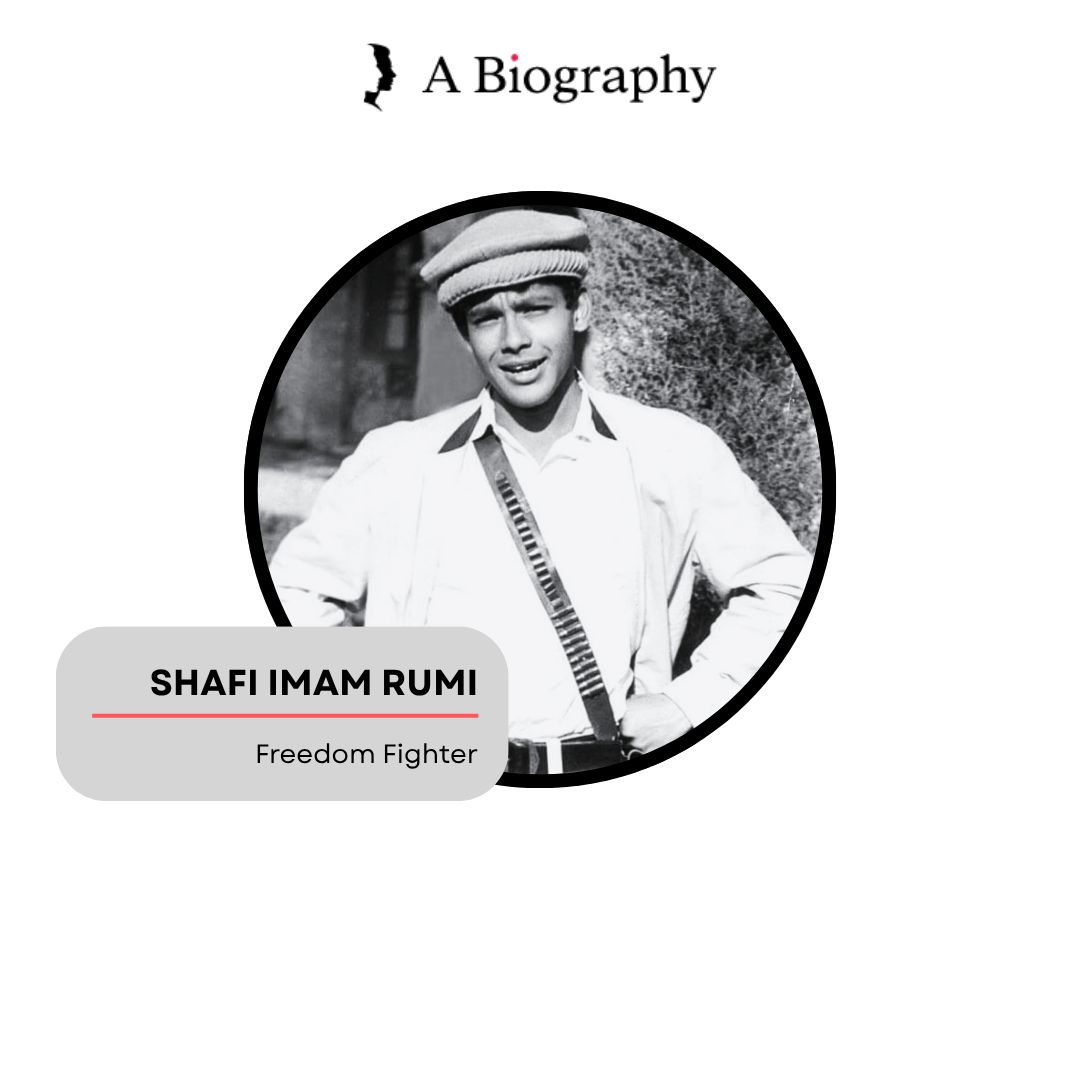
Table of Contents
ToggleBiography of Shafi Imam Rumi
Freedom Fighter
(29th March, 1951- 4th September, 1971)
Summary
“If you send me to America now, maybe I’ll go, but if I leave the country, how will I see myself?” – Shafi Imam Rumi asked this question to his mother, Jahanara Imam.
In 1971, Shafi Imam Rumi led and succeeded in numerous guerrilla missions. He was born on March 29, 1951, in Dhaka. He was extremely talented from childhood. His father’s name was Sharif Imam. His mother’s book, Ekattorer Dinguli, was written with Rumi’s war-filled memories. Rumi passed his matriculation in 1968 from Adamjee Cantonment Public School and College. He secured the 3rd position on the Pakistan Board merit list. While in college, he earned the rank of sergeant in the University Officers Training Corps. In 1971, he enrolled at BUET. He also got admission to the Illinois Institute of Technology in Chicago, USA. But he stayed in Bangladesh for the war. He received his training in Tripura’s Melaghar and Agartala’s Sector-2. At that time, Major Rashid Haider and Major Khaled Mosharraf served under Sector-2. Rumi’s main mission was to destroy the Siddhirganj Power Station. Rumi, along with his friends, conducted many hit-and-run missions. They carried out guerrilla attacks at various locations regularly. Their most successful mission was in Dhanmondi on Road No. 18. On the night of August 29, the Pakistani forces arrested Rumi and his father Sharif Imam from Mirpur Road. From there, they were taken to Elephant Road. This operation was led by Captain Qayum. He had ordered the arrests of artist Altaf Mahmud, Abul Barak, and Azad. Rumi was kept in a small room at Dhaka Cantonment and tortured throughout the night. On September 2, many of Rumi’s team members were released. Sharif Imam and Jami were released on September 4. Rumi, along with Jewel, Bodi, and others, was detained and never found again. During the Liberation War, charges of genocide, intellectual killings, conspiracy, and abduction were filed against Ali Mohammad Mojaheed in five cases.
Introduction
Shafi Imam Rumi, the eldest son of the writer Jahanara Imam served as a guerilla fighter in the 1971 liberation war. “Ekattorer Dinguli” was written in Rumi’s memory by his mother. From his childhood he was very intelligent. Rumi was killed during the war.
Life of " Shafi Imam Rumi " a Glance
Personal Details
➢ Full Name: Shafi Imam Rumi
➢ Date of Birth: 29 March 1951
➢ Birth Place: Azimpur, Dhaka, East Pakistan (now Bangladesh)
➢ Died: September 1971 (aged 20)
➢ Cause of Death: Executed by Pakistani forces
➢ Burial Site: Unknown (body never recovered)
➢ Religion: Islam
➢ Nationality: Bangladeshi
➢ Parents: Jahanara Imam (mother), Sharif Imam (father)
Education
➢ Matriculation: Adamjee Cantonment Public School & College (1968)
➢ Achievement: Ranked 3rd in Pakistan Education Board merit list
➢ Military Training: University Officers Training Corps (Sergeant rank)
➢ Higher Education:
-Admitted to BUET (1971)
-Accepted at Illinois Institute of Technology, Chicago (deferred for war)
Liberation War Role
➢ Training:
-Trained in Melaghar & Agartala, India (Sector 2)
-Under command of Majors Khaled Mosharraf & Rashid Haider
➢ Guerrilla Operations:
-Primary mission: Destroy Siddhirganj Power Station
-Led successful hit-and-run attacks across Dhaka
-Notable operation: Dhanmondi Road 18 ambush (25 August 1971)
Arrest & Martyrdom
➢ Arrest: Captured with father on 29 August 1971 from Mirpur Road
➢ Interrogation: Tortured at Dhaka Cantonment detention camp
➢ Execution: Never released; presumed executed in early September 1971
➢ Justice: Ali Ahsan Mohammad Mojaheed convicted for his murder (2015)
Legacy
➢ Memorial: “Shaheed Rumi Moncho” at Adamjee Cantonment College
➢ Literary Immortality: Central figure in mother’s book Ekattorer Dinguli
➢ Cultural Depiction: Portrayed by Wahaj Ali in drama Jo Bichar Gaye (2022)
➢ Posthumous Honor: Mother Jahanara Imam titled “Shaheed Janani”
Little-Known Facts
➢ Refused US education: “How will I see myself if I leave my country now?”
➢ Led guerrilla unit “Crack Platoon” at age 20
➢ Operation vehicle: Black Morris Oxford used in Dhanmondi ambush
➢ Father died of heart attack days before Bangladesh’s victory (13 Dec 1971)
Early Life
He was born in 1951 on 29th March in Dhaka, Azimpur. Sharif Imam, his father, was also a freedom fighter. Rumi belonged to a well-off middle class family. Completed his SSC degree from Adamjee Cantonment Public School and College in 1968. He stood 3rd in the Pakistan Education Board during that year. When he was in college, he joined the University Officers Training Corps. He was so good that he was ranked Sergeant. After completing his college education, he got admitted into the Bangladesh University of Engineering and Technology (BUET) in 1971. He was also enrolled in Illinois Institute of Technology, a research based university situated In Chicago, USA. But he could not attend classes because the war had already started and he wanted to stay in the country.
Rumi barely turned 20 years old in 1971. Rumi frequently asked his family, specifically his mother about joining in the war during the earliest period. But his mother was against the idea of her eldest son going to the war. “”If you send me away to America, maybe I’ll end up going, but will I be able to look at myself if I leave now?” – he asked his mother. It was described in the book ‘Ekattorer Dinguli’. He wanted the utmost blessing of his parents before taking part in the war. His stubborn determination won at last. Eventually his mother agreed on 19th April, and he was able to join the war.
Training
Rumi, the apple of his mother’s eyes, who was very sensitive to his food and clothes, accepted the struggles very easily. He starved of food, soaked in rain, stood and walked on the mud for the sake of his motherland and the people.
Pakistani army was already causing massacres everywhere and kept their killings and destruction a secret by creating an impression that everything was right. But the horror came out in the light eventually.
On the May of 2nd, Rumi went to cross the Indian border. But failed due to the adverse circumstances in the border area. He successfully crossed the border on the second attempt. Under sector-2, he started his training in Melaghar and Agartala, located in the Indian state of Tripura. Major Khaled Mosharraf(10th April-22nd September) and Major Rashid Haider(Sector Commander, 22nd September-6th April) were in charge of sector-2. Districts of Dhaka, Comilla, Faridpur and some portions of Noakhali were part of sector 2. After training he came back to Dhaka to join Crack Platoon to become a guerilla fighter.
Mission and contribution
Rumi’s main mission was to terminate Siddhirganj Power Station. But that place was heavily protected. They had to come up with new ideas and strategies with heavier weapons. He carried out many hit and run attacks with his comrades. Rumi and his fellow fighters played crucial roles in Dhaka guerilla warfare. They took part in targeted military operations. Their guerilla attacks were very regular. Rumi and his friends carried out a successful mission on 25th August, in the Dhanmondi Road No. 18, shooting Pakistani soldiers from a black Morris Oxford. This mission made him a leader figure in his group.
They were on a break during a crackdown around 29th August, 1971. The Mukti Bahini resumed their mission at the end of September. They continued their attacks until Pakistan surrendered in December, 1971.
Arrest by the Pakistani Army
On the night of 29th August, Rumi was arrested along with his father, brother and cousin by the Pakistani military. This operation was led by Captain Quayyum, who gave orders to arrest other people including artist Altaf Mahmud, Abul Barak and Rumi’s colleague Azad that night. They were taken to Mirpur and then Elephant Road. They were kept in a small room in Dhaka cantonment and tortured there. They got arrested because the Pakistani army found out about Rumi’s operations in Dhaka city. One of Rumi’s friends named Bodi told everything to them and took responsibility for the attacks that happened. Rumi’s friend Sharif and Jami gave the exact statement. All these were happening while Rumi’s family was unaware about everything. On the 2nd September, Rumi’s cousin got freed because he wasn’t a permanent member of Rumi’s residence. Sharif and Jami were also released on 4th September. Rumi, Jewel, Bodi and his other fellow fighters were never released nor found. They were executed. On 29th August all the members of Mukti Bahini were arrested. Rumi’s parents did not even ask for mass mercy to the Yahya Khan as it would be disrespectful towards Rumi’s ideology.
Death of Rumi’s Father
Rumi’s father died of a heart attack on 13th December, 1971. He was taken to the PG hospital. He could not take proper treatment due to the blackouts caused by the Indo-Pak war. He died there.
Justice for Rumi
Ali Ahsan Mohammad Mojaheed was found guilty of 5 out of 7 charges of genocide, conspiracy, to kill intellectuals, murder, and torture and brought to life sentence because of killing Rumi along with Badi, Jewel, Azad, and Altaf Mahmud at Nakhalpara army camp during 1971. For being the mother of a martyr, Jahanara Imam was given the title “Shaheed Janani” (Mother of Martyr) for life.
Legacy
A symposium was built in the memory of Imam Shafi Rumi at the Adamjee Cantonment College(ACC) called “Shaheed Rumi Moncho”.
Contributions
He contributed to hundreds of guerilla warfare as a group leader. Prosecuted hit and run attacks. Lead targeted missions
Drama Adaptation
In 2022, Geo Entertainment of Pakistan released a drama called ‘Jo Bichar Gaye’ based on the Bangladesh’s Liberation War. Shafi Imam Rumi was one of the main characters, played by Wahaj Ali.
Conclusion
In the history of Bangladesh, Shafi Imam Rumi will always remain as the young boy who was bright and talented with so many gifts, could do anything and go anywhere but chose the freedom of his country and the people. The name of the patriots of Bangladesh is always remembered with Rumi’s name at the top.
Reference
1.https://www.thedailystar.net/life-living/news/remembering-shaheed-rumi-3283741
2.https://en.wikipedia.org/wiki/Shafi_Imam_Rumi
3.https://www.thedailystar.net/my-dhaka/news/remembering-shaheed-shafi-imam-rumi-memories-brother-3516696
Disclaimer
All content on this website is provided in good faith and only for general information purposes. A Biography makes no guarantees regarding the information’s completeness, reliability, or correctness. Any action you take as a result of the material on this website is entirely at your own risk. A Biography is not responsible for any losses or damages incurred as a result of using our website.

